
April 2026
Preparing for Springtime

Renewal of Intentions
Spring invites us to renew our intentions, often igniting a spark within as we shed the weight of winter’s stillness. Together, we can embrace this season of rebirth and allow the vibrant energy around us to seep into our minds and hearts.
For some, this means intentional journaling, where we pour out our thoughts onto the page. Others may choose to gather their scattered aspirations and potentially find clarity in goal-setting. We can often take a moment to reflect on what truly matters to us, honing in on the desires that resonate with our spirits.
Embracing Change
Change often sneaks up on us in the springtime, inviting us to step into the unknown with open hearts. If we embrace this season of transformation, it opens us up to recognizing that each shift holds the promise of personal growth.
Everyone reacts to change differently, but time has taught us that most of us react best when we follow some general, simple guidance:
- Acknowledge our Feelings: Honor the emotions that can arise as we navigate changes. Understand that they are just part of the journey.
- Trust the Process: Embracing uncertainty opens doors to possibilities we never imagined.
- Cultivate Resilience: Each challenge we face strengthens our spirits, shaping us into who we’re meant to be.
- Celebrate Small Wins: In every journey, it’s important to recognize and rejoice in our progress, no matter how small.
When we embrace change in this manner, we create a sacred space in which, like the spring flowers, we too can bloom anew and rise with the sun.
Spiritual Cleansing
As the vibrant colors of nature start to burst forth in the springtime, many often find themselves called to a practice of spiritual cleansing in an effort to shed the winter-weight that clings to our spirits. Some view this process as commencing on a journey of inner clarity, inviting the Light to illuminate our shadows and dark places. There are many, many ways to do this, but below are 4 ways that have been used through the ages.
- Meditation: We can sit in silence, allowing our breath to guide us, as we visualize releasing our pent-up negativity back to the earth.
- Nature Walks: By immersing ourselves in nature, we can absorb its renewing energy, grounding ourselves and shedding what no longer serves us.
- Journaling: Writing down our thoughts and emotions allows us to confront and release burdens, making space for new growth.
- Ritual Bathing: We can create a ritual bath with herbs and essential oils, symbolizing our intention to wash away the past.
Quaker Queries:
- What am I willing to let go of to welcome in the new season?
- What am I willing to let in to welcome in the new season?
March 2026
Paying Attention
A long-term mentor of mine used to remind me all the time….”Pay attention to what you’re paying attention to!” For the longest time, I didn’t understand what he meant, but eventually, I came to see that I was a very scattered thinker…..much like the dog running in the park from one “squirrel” to the next “squirrel” and catching nothing but tired legs. I didn’t understand then what “Paying Attention” even meant….but over time and with some practice, I learned.

Paying attention is the act of focusing your mind on something or someone carefully, often to
understand, learn, or respond effectively.
Definition and Meaning:
Definition and Meaning
Paying attention involves applying your mind to a task, person, or situation with interest and awareness, whether by watching, listening, or thinking carefully. It is a fundamental cognitive skill that allows individuals to process information, make decisions, and respond appropriately.
Down below is a clickable link that should take you to a short exercise to help you get control of your very busy mind.
Remember….pay attention to what you’re paying attention to.
https://workmindfulness.com/mindfulness-meditation-pay-attention/
Quaker Queries on Paying Attention:
- When I don’t hear the Spirit speak to me, is it because he isn’t speaking, or because I’m not paying attention?
- When a F(f)riends tries to talk to me about their problems, are they not communicating effectively, or am I not paying close attention to them?
- Before an important conversation, do I take the time to quiet my mind so I can pay attention?
- Do I take the time to “Pay attention to what I’m paying attention to?”
February 2026
Building your resilience
We all face trauma, adversity, and other stresses. Here’s a roadmap for adapting to life-changing situations, and emerging even stronger than before.


Imagine you’re going to take a raft trip down a river. Along with slow water and shallows, your map shows that you will encounter unavoidable rapids and turns. How would you make sure you can safely cross the rough waters and handle any unexpected problems that come from the challenge?
Perhaps you would enlist the support of more experienced rafters as you plan your route or rely on the companionship of trusted friends along the way. Maybe you would pack an extra life jacket or consider using a stronger raft. With the right tools and supports in place, one thing is sure: You will not only make it through the challenges of your river adventure. You will also emerge a more confident and courageous rafter.
What is resilience?
Life may not come with a map, but everyone will experience twists and turns, from everyday challenges to traumatic events with more lasting impact, like the death of a loved one, a life-altering accident, or a serious illness. Each change affects people differently, bringing a unique flood of thoughts, strong emotions, and uncertainty. Yet people generally adapt well over time to life-changing situations and stressful situations—in part thanks to resilience.
Psychologists define resilience as the process of adapting well in the face of adversity, trauma, tragedy, threats, or significant sources of stress—such as family and relationship problems, serious health problems, or workplace and financial stressors. As much as resilience involves “bouncing back” from these difficult experiences, it can also involve profound personal growth.
While these adverse events, much like rough river waters, are certainly painful and difficult, they don’t have to determine the outcome of your life. There are many aspects of your life you can control, modify, and grow with. That’s the role of resilience. Becoming more resilient not only helps you get through difficult circumstances, it also empowers you to grow and even improve your life along the way.
What resilience isn’t
Being resilient doesn’t mean that a person won’t experience difficulty or distress. People who have suffered major adversity or trauma in their lives commonly experience emotional pain and stress. In fact, the road to resilience is likely to involve considerable emotional distress.
While certain factors might make some individuals more resilient than others, resilience isn’t necessarily a personality trait that only some people possess. On the contrary, resilience involves behaviors, thoughts, and actions that anyone can learn and develop. The ability to learn resilience is one reason research has shown that resilience is ordinary, not extraordinary. One example is the response of many Americans to the September 11, 2001 terrorist attacks and individuals’ efforts to rebuild their lives after tragedy.
Like building a muscle, increasing your resilience takes time and intentionality. Focusing on four core components—connection, wellness, healthy thinking, and meaning—can empower you to withstand and learn from difficult and traumatic experiences. To increase your capacity for resilience to weather—and grow from—the difficulties, use these strategies.
Build your connections will help
Prioritize relationships. Connecting with empathetic and understanding people can remind you that you’re not alone in the midst of difficulties. Focus on finding trustworthy and compassionate individuals who validate your feelings, which will support the skill of resilience.
The pain of traumatic events can lead some people to isolate themselves, but it’s important to accept help and support from those who care about you. Whether you go on a weekly date night with your spouse or plan a lunch out with a friend, try to prioritize genuinely connecting with people who care about you.
Join a group. Along with one-on-one relationships, some people find that being active in civic groups, faith-based communities, or other local organizations provides social support and can help you reclaim hope. Research groups in your area that could offer you support and a sense of purpose or joy when you need it.
Foster wellness
Take care of your body. Self-care may be a popular buzzword, but it’s also a legitimate practice for mental health and building resilience. That’s because stress is just as much physical as it is emotional. Promoting positive lifestyle factors like proper nutrition, ample sleep, hydration, and regular exercise can strengthen your body to adapt to stress and reduce the toll of emotions like anxiety or depression.
Practice mindfulness. Mindful journaling, yoga, and other spiritual practices like prayer or meditation can also help people build connections and restore hope, which can prime them to deal with situations that require resilience. When you journal, meditate, or pray, ruminate on positive aspects of your life and recall the things you’re grateful for, even during personal trials.
Avoid negative outlets. It may be tempting to mask your pain with alcohol, drugs, or other substances, but that’s like putting a bandage on a deep wound. Focus instead on giving your body resources to manage stress, rather than seeking to eliminate the feeling of stress altogether.
Find purpose
Help others. Whether you volunteer with a local homeless shelter or simply support a friend in their own time of need, you can garner a sense of purpose, foster self-worth, connect with other people, and tangibly help others, all of which can empower you to grow in resilience.
Be proactive. It’s helpful to acknowledge and accept your emotions during hard times, but it’s also important to help you foster self-discovery by asking yourself, “What can I do about a problem in my life?” If the problems seem too big to tackle, break them down into manageable pieces.
For example, if you got laid off at work, you may not be able to convince your boss it was a mistake to let you go. But you can spend an hour each day developing your top strengths or working on your resume. Taking initiative will remind you that you can muster motivation and purpose even during stressful periods of your life, increasing the likelihood that you’ll rise up during painful times again.
Move toward your goals. Develop some realistic goals and do something regularly—even if it seems like a small accomplishment—that enables you to move toward the things you want to accomplish. Instead of focusing on tasks that seem unachievable, ask yourself, “What’s one thing I know I can accomplish today that helps me move in the direction I want to go?” For example, if you’re struggling with the loss of a loved one and you want to move forward, you could join a grief support group in your area.
Look for opportunities for self-discovery. People often find that they have grown in some respect as a result of a struggle. For example, after a tragedy or hardship, people have reported better relationships and a greater sense of strength, even while feeling vulnerable. That can increase their sense of self-worth and heighten their appreciation for life.
Embrace healthy thoughts
Keep things in perspective. How you think can play a significant part in how you feel—and how resilient you are when faced with obstacles. Try to identify areas of irrational thinking, such as a tendency to catastrophize difficulties or assume the world is out to get you, and adopt a more balanced and realistic thinking pattern. For instance, if you feel overwhelmed by a challenge, remind yourself that what happened to you isn’t an indicator of how your future will go, and that you’re not helpless. You may not be able to change a highly stressful event, but you can change how you interpret and respond to it.
Accept change. Accept that change is a part of life. Certain goals or ideals may no longer be attainable as a result of adverse situations in your life. Accepting circumstances that cannot be changed can help you focus on circumstances that you can alter.
Maintain a hopeful outlook. It’s hard to be positive when life isn’t going your way. An optimistic outlook empowers you to expect that good things will happen to you. Try visualizing what you want, rather than worrying about what you fear. Along the way, note any subtle ways in which you start to feel better as you deal with difficult situations.
Learn from your past. By looking back at who or what was helpful in previous times of distress, you may discover how you can respond effectively to new difficult situations. Remind yourself of where you’ve been able to find strength and ask yourself what you’ve learned from those experiences.
Seeking help
Getting help when you need it is crucial in building your resilience.
For many people, using their own resources and the kinds of strategies listed above may be enough for building their resilience. But at times, an individual might get stuck or have difficulty making progress on the road to resilience.
A licensed mental health professional such as a psychologist can assist people in developing an appropriate strategy for moving forward. It is important to get professional help if you feel like you are unable to function as well as you would like or perform basic activities of daily living as a result of a traumatic or other stressful life experience. Keep in mind that different people tend to be comfortable with different styles of interaction. To get the most out of your therapeutic relationship, you should feel at ease with a mental health professional or in a support group.
The important thing is to remember you’re not alone on the journey. While you may not be able to control all of your circumstances, you can grow by focusing on the aspects of life’s challenges you can manage with the support of loved ones and trusted professionals.
Quaker Queries:
If I want to be strong and resilient, am I doing the things necessary to get there?
Am I helping others perhaps less fortunate along while I’m on this path to personal improvement?
January 2026
Finding our Center
Welcome to the Path of Finding Our Center….
When we talk of finding our center, it’s natural for calm and rest to be the first things
that come to mind. Who would expect anything different? After all, the need for calm is
everywhere we look. So, so many of us are tired. We’re overworked, over-busy, over-committed,
overly scared. We are often so weighed down by responsibility and worry
that it only takes one drop of something unexpected to tip us over. So, yes, we long for
rest.
Yes, we want to swirl to stop.
And yet, helping us find peace and calm is not the only work found on this path of
finding our center.
As our faith reminds us, being a “centered person” often involves the opposite of
keeping things calm. To move toward a balance of justice, we have to upset the
current state of things. Oppressive systems need to be challenged and toppled. And to
accomplish that, we sometimes need to sacrifice calm and comfort, including our own. We need to
to remember that achieving a balance of equality requires us to be purposefully off
balance and out of step with our culture, or as Martin Luther King Jr. said, we need
people who are maladjusted to the way things are.
Add all this up, and suddenly “our center” appears to be a much richer place than it is
often recognized
.
It’s not simply a place of peace and calm; it’s also a place of being pushed and launched.
What you hear in this deep space within is not just the whisper of “Rest” and “Breathe,”
but also “Take a deep breath and jump!” We encounter an invitation there, not just
relaxation. It’s a still point, yes. But a still point upon which we pivot and turn to
something new.
So, as we try to make sense of “finding our center” this month, it’s fine to pull up the
image of the Buddha sitting peacefully under a tree, but we can’t let that overshadow
the image of a diver balancing way up there on her diving board, pausing to regain her
composure and courage so she can leap and go “all in.”
Maybe in the end, instead of only asking each other, “Are you centered these days?” we
need to ask, “Where is your center sending you these days?” and “Where is your center
Calling you to go?”
Query and exercise:
Don’t treat these questions like “homework” or try to answer every one. Instead, make time to meditate on the list and then pick the one question that speaks to you most. The goal is to figure out which question is “yours.” Which question captures the call of your inner voice? Which one contains “your work”? And what is that question trying to get you to notice or acknowledge? Often it helps to read the list to a friend or loved one and ask them which question they think is the question you need to wrestle with!
- Who first helped you find your true self?
- Who first helped you find “the fire in your belly”?
- What do you do to stay in touch with the fire in your belly?
- What if you find your center when remembering the nicest thing someone ever said to you?
- When was the last time someone asked you about that which lies at the deepest center of who
you are? - Is it possible that the discovery of your deepest self lies in paying attention to the person that
annoys you the most? - Who were you before others told you, “You’re too much!” or “You’re not good enough!”?
- What three things most moved you toward your center this past year?
- Have you ever felt like you “are finally catching up to who you are”?
- What happens inside you in the silent moments? What do you hear? What do you feel?
- What have you learned about navigating those times in life when we lose track of our center?
December
Friendship
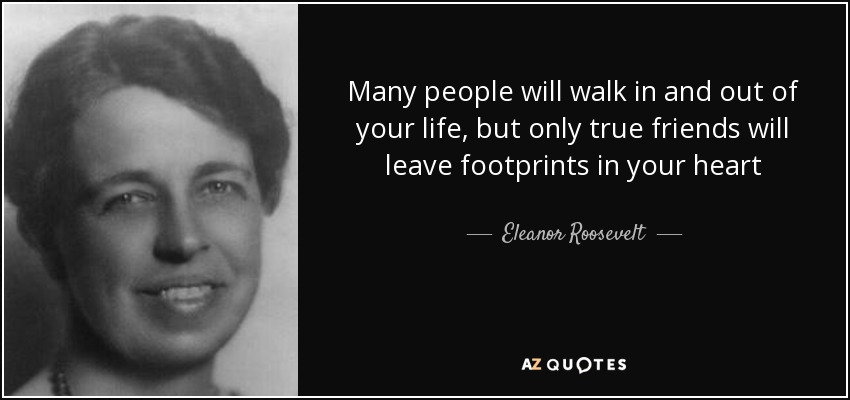
Thoughts on Friendship:
Most of us have a rather large bubble of “friends”, but most of us only find true, deep, long-lasting friendship a handful of times in our entire lives. Almost as many thoughts on friendship have been published as thoughts about love. For this December, here are a few thoughts about “Friendship” to consider….Merry Christmas!
“A real friend is one who walks in when the rest of the world walks out.”
– Walter Winchell
“If you live to be 100, I hope I live to be 100 minus 1 day, so I never have to live without you.”
– Winnie the Pooh
“Friendship is born at that moment when one person says to another, ‘What! You too? I thought I was the only one.”
– C.S. Lewis
“True friendship comes when the silence between two people is comfortable.”
– David Tyson
“There’s not a word yet for old friends who’ve just met.”
– Jim Henson
“Don’t make friends who are comfortable to be with. Make friends who will force you to lever yourself up.”
– Thomas J. Watson
“You can make more friends in two months by becoming interested in other people than you can in two years by trying to get other people interested in you.”
— Dale Carnegie
“A friend is someone who understands your past, believes in your future, and accepts you just the way you are.”
– Unknown
“Ultimately the bond of all companionship, whether in marriage or in friendship, is conversation.”
– Oscar Wilde
“How many slams in an old screen door? Depends how loud you shut it. How many slices in a bread? Depends how thin you cut it. How much good inside a day? Depends how good you live ’em. How much love inside a friend? Depends how much you give ’em.”
– Shel Silverstein
“A true friend never gets in your way unless you happen to be going down.”
– Arnold H. Glasgow
“I don’t need a friend who changes when I change and who nods when I nod; my shadow does that much better.”
– Plutarch
“In everyone’s life, at some time, our inner fire goes out. It is then burst into flame by an encounter with another human being. We should all be thankful for those people who rekindle the inner spirit.”
– Albert Schweitzer
“A loyal friend laughs at your jokes when they’re not so good, and sympathizes with your problems when they’re not so bad.”
– Arnold H. Glasgow
“It is not a lack of love, but a lack of friendship that makes unhappy marriages.”
– Friedrich Nietzsche
“Friendship is the hardest thing in the world to explain. It’s not something you learn in school. But if you haven’t learned the meaning of friendship, you really haven’t learned anything.”
– Muhammad Ali
“If ever there is tomorrow when we’re not together… there is something you must always remember. You are braver than you believe, stronger than you seem, and smarter than you think. But the most important thing is, even if we’re apart… I’ll always be with you.”
– Winnie the Pooh
“Growing apart doesn’t change the fact that for a long time we grew side by side; our roots will always be tangled. I’m glad for that.”
– Ally Condie
“One’s friends are that part of the human race with which one can be human.”
– George Santayana
“Be slow to fall into friendship; but when thou art in, continue firm and constant.”
– Socrates
“One measure of friendship consists not in the number of things friends can discuss, but in the number of things they need no longer mention.”
– Clifton Fadiman
“Never idealize others. They will never live up to your expectations. Don’t over-analyze your relationships. Stop playing games. A growing relationship can only be nurtured by genuineness. “
– Leo F. Buscaglia
“In the End, we will remember not the words of our enemies, but the silence of our friends.”
– Martin Luther King, Jr.
“Let us be grateful to the people who make us happy; they are the charming gardeners who make our souls blossom.”
– Marcel Proust
“Tis the privilege of friendship to talk nonsense, and to have her nonsense respected.”
– Charles Lamb
“If you go looking for a friend, you’re going to find they’re very scarce. If you go out to be a friend, you’ll find them everywhere.”
– Zig Ziglar
“You can always tell a real friend: when you’ve made a fool of yourself he doesn’t feel you’ve done a permanent job.”
– Laurence J. Peter
“Keep away from those who try to belittle your ambitions. Small people always do that, but the really great make you believe that you too can become great.”
– Mark Twain
“Flatter me, and I may not believe you. Criticize me, and I may not like you. Ignore me, and I may not forgive you. Encourage me, and I will not forget you. Love me and I may be forced to love you.”
– William Arthur Ward
“No person is your friend who demands your silence, or denies your right to grow.”
– Alice Walker
“Friendship is the only cement that will ever hold the world together.”
– Woodrow T. Wilson
“Friends are those rare people who ask how we are and then wait to hear the answer.”
– Ed Cunningham
“Anybody can sympathize with the sufferings of a friend, but it requires a very fine nature to sympathize with a friend’s success.”
– Oscar Wilde
“The most beautiful discovery true friends make is that they can grow separately without growing apart.”
– Elisabeth Foley
“Lots of people want to ride with you in the limo, but what you want is someone who will take the bus with you when the limo breaks down.”
— Oprah Winfrey
“Do not keep on with a mockery of friendship after the substance is gone — but part, while you can part friends. Bury the carcass of friendship: it is not worth embalming.”
– William Hazlitt
“When you stop expecting people to be perfect, you can like them for who they are.”
– Donald Miller
“Each friend represents a world in us, a world possibly not born until they arrive, and it is only by this meeting that a new world is born.”
– Anais Nin
“A true friend is someone who thinks that you are a good egg even though he knows that you are slightly cracked.”
– Bernard Meltzer
“The greatest compliment that was ever paid me was when someone asked me what I thought, and attended to my answer.”
— Henry David Thoreau
“People are lonely because they build walls instead of bridges.”
— Joseph F. Newton Men
“Friendship is like a glass ornament, once it is broken it can rarely be put back together exactly the same way.”
– Charles Kingsley
“A friend knows the song in my heart and sings it to me when my memory fails.”
– Donna Roberts
“There is nothing better than a friend, unless it is a friend with chocolate. “
– Linda Grayson
“Sometimes being a friend means mastering the art of timing. There is a time for silence. A time to let go and allow people to hurl themselves into their own destiny. And a time to prepare to pick up the pieces when it’s all over.”
– Gloria Naylor
November
Spiritual Gifts

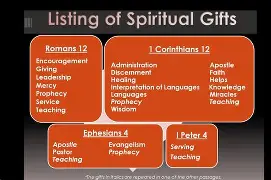
The picture above is what most people think about when the subject of “Gifts” comes up, and while I like gifts as much as anyone else, these types of gifts…while fun to get…are not the type of gifts Quakers are talking about this time of year. For those F(f)riends more rooted in scripture, the Bible mentions several kinds of spiritual gifts, and the common theme for all of them is that they are directed outwards…towards others or towards groups that support others. Gifts are a way to perform the type of service that we are all called to do in this world. Nobody has all of the gifts, but everyone has at least one of them, and if our groups do it right, the various people with the various gifts somehow find a way to dovetail the gifts of one person to the gifts of another in service to others. Somehow….Tab “A” fits into slot “B” and is glued in place with whatever gifts support and complement that union. Ultimately, we all end up being of service to each other, and the group grows and thrives from the experience.
A little clue to pass on to anyone who reads this entry: Gifts feel natural. It’s easy to name the gifts of others because we can see them in real time as those people go about their lives. We can easily name someone with the gift of “Service”…or maybe “Teaching”.
As outsiders, we are not emotionally tangled up with their opinions of themselves, so we can see them live out their gifts clearly. BUT! If you ask that very same person what their spiritual gifts are, they often say that they don’t have any gifts of that type. They are just doing what they have always done. It’s natural to them. We often do not see our own giftedness. Quakers have long known that the spiritual gifts of one person are best named by others.
Quaker Queries:
- How do the things in my life that interest me relate to these listed spiritual gifts?
2. Am I willing to take an honest, hard look at my own giftedness?
3. Can I see the spiritual gifts in others?
4. Can I accept that others can see my gifts better than I can?
October

Future Service Animal
Service
September
Unity
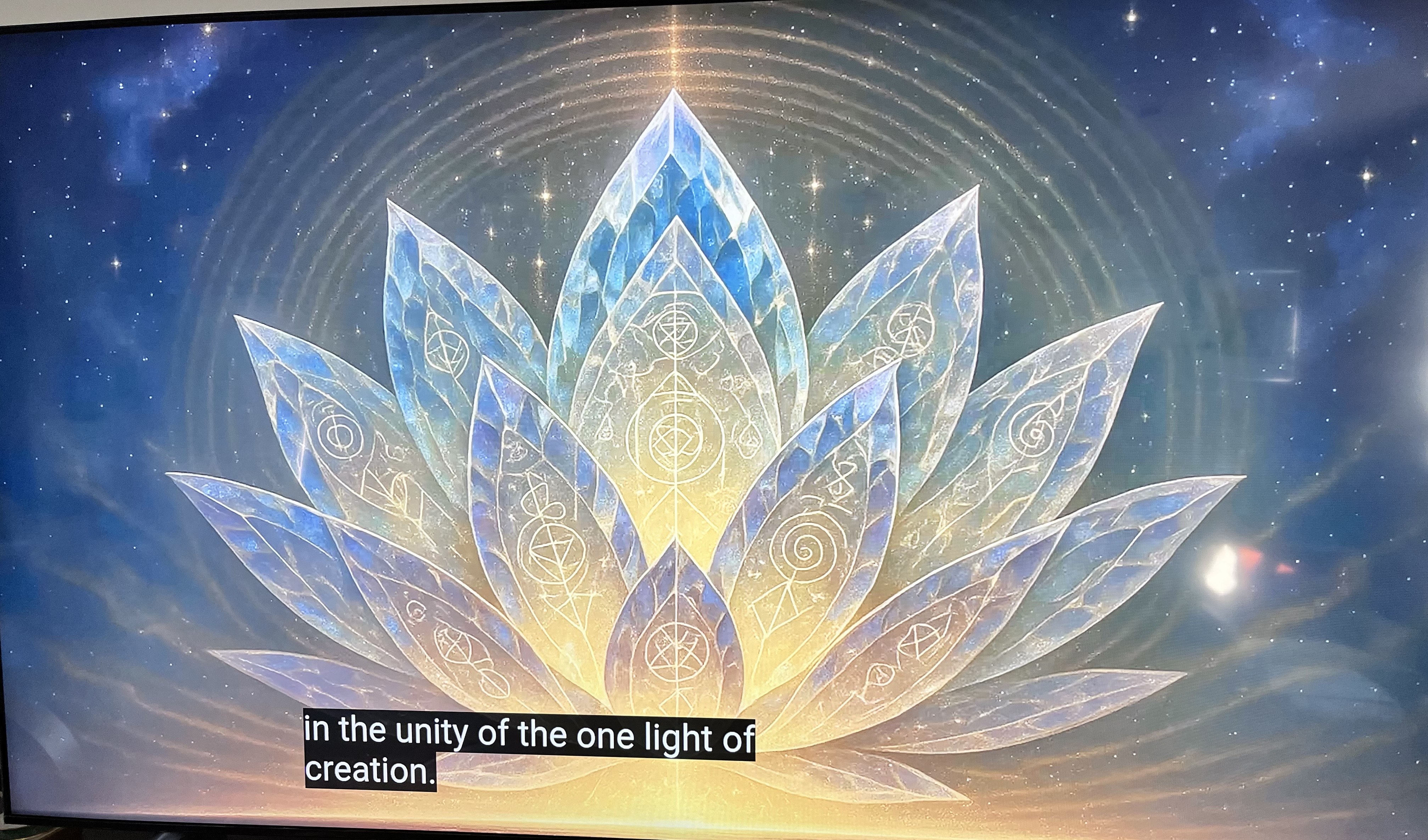
Definition: Quaker unity is a deep, collective search for and commitment to Divine guidance and truth that allows a community to move forward together despite individual differences in belief or opinion. It’s not about everyone agreeing or achieving unanimity; rather, it’s a spiritual connection that binds people as a community, emphasizing mutual love and the acceptance of diversity as a strength in their shared pursuit of truth.
It is distinct from consensus, which might be a compromise; unity is a deeper belief in the rightness of the decision for the entire community.
Quaker Query on Unity:
Do we seek to nurture a spirit of unity in our Meeting? If a problem or conflict arises within the Meeting, do we make timely efforts to address the issue in a spirit of love and humility? As we seek unity, do we listen to one another carefully and with openness to Truth?
The Flame of Unity
In the heart of a village, where shadows once fell,
Hope flickered like embers, a soft glowing swell.
From the whispers of anguish, a new song would rise,
As hearts intertwined, they reached for the skies.
Together they gathered, in joy and in strife,
Each voice a mere candle, yet revealing new life.
They danced with the night winds, their laughter a thread,
Weaving dreams of tomorrow where all could be fed.
With hands held together, they forged mighty chains,
Transforming their sorrows into triumphant gains.
In the fire of purpose, each spirit grew bright,
Uniting their passions, they banished the night.
For hope is a beacon, a light we can share,
An unyielding promise that blooms in the air.
In the warmth of their circle, no one stood alone,
When hearts come together, it’s love that has grown.
So sing of their journey, of strength born of grace,
In Unity’s garden, they all found their place.
With a flame ever burning, and voices in flight,
Hope ignites the spirit, shining ever so bright.
(Author Unknown)
August 2025

Spiritual Energy and Healing
Quotation for consideration:
Spirituality is the face and body of the universe. It is the connective tissue of the entire cosmos, that stuff of which we are made. It is the experience of being made whole and connected to all others, where we get to view it in real-time.
From the book “Hands of Light” by Barbara Ann Brennan
Quaker Queries on Spiritual Energy and Healing:
- Do I take time to rest and rejuvenate my spiritual life? Do I tend to my own light?
- Do I take the time to share my energy with others who may need some help healing?
- Do I stop and pause to be grateful for what I have received?
Where The Quiet Dwells
Quiet yourself.
Sit Still.
Let life find you there–
Tiny souls like ants and spiders,
Greater ones like squirrels and birds,
The steady ones like trees and rocks.
They come when silence opens the door.
They arrive when you no longer seek.
As a child, I sat on grassy knolls,
In my youth, I wandered for hours
On hills, through the wild, rocky paths,
Breathing in the salt of the earth,
Tracing every scent and shadow.
Yet, only in the valley’s mud,
Where the river swelled with restless might,
Did I hear, for the first time,
The mountain’s gentle hidden song.
In that sound, I heard the world’s own breath,
A rhythm older than my years–
A call to pause, to rest, to trust,
That life would find me if I stayed
Still enough to hear it’s noted,
Bold enough to walk its way.
Now, when I return to silence,
I hear more than I could before–
The secret song of hidden things,
The murmur of an ancient shore,
Where stillness speaks and water sings,
And I find myself in everything.
Author: Our Friend Tony Pfannenstiel (with the permission of Betsy Pfannenstiel)
July 2025

Note*We will begin sharing “Soup and Bread” on the second Sundays of each month beginning on July 13, 2025.
Quaker Advices on Love
- Take heed, dear Friends, to the promptings of love and truth in your hearts. Seek to live in affection as true Friends in your meetings, in your families, in all your dealing with others, and in your relationship with outward society.
- Seek to lead others to Truth through love. Let us teach by being ourselves teachable. We are all humble learners in the school of Christ.
- Do not fear periods of doubt and questions; they may lead to openings.
Loving Against All Odds
I believe in belief,
yet I hold on to hope.
I do not believe in God–
For I know God exists.
God is not a question;
God is a knowing
But love–
love is where I stumble.
I look around and see so little of it,
so much hatred and division,
nations at war,
a world torn apart.
Be truthful friends–
it is love that needs our faith.
Imagine if our hearts were wide enough
to hold the hurt and spite of others,
their fears, their failures,
their rage and resentment–
so love could swell
to encircle their wounds
and more,
to pour over them like rain.
That is the miracle–
to stand against the storm,
to scream into the void,
to fight with every breath
against the weight of the world,
and still, to reach out–
to hold the broken,
to cradle the lost,
to love so fiercely
that even the darkness trembles.
Author: Our Friend Tony Pfannenstiel (with the permission of Betsy Pfannenstiel)
June 2025
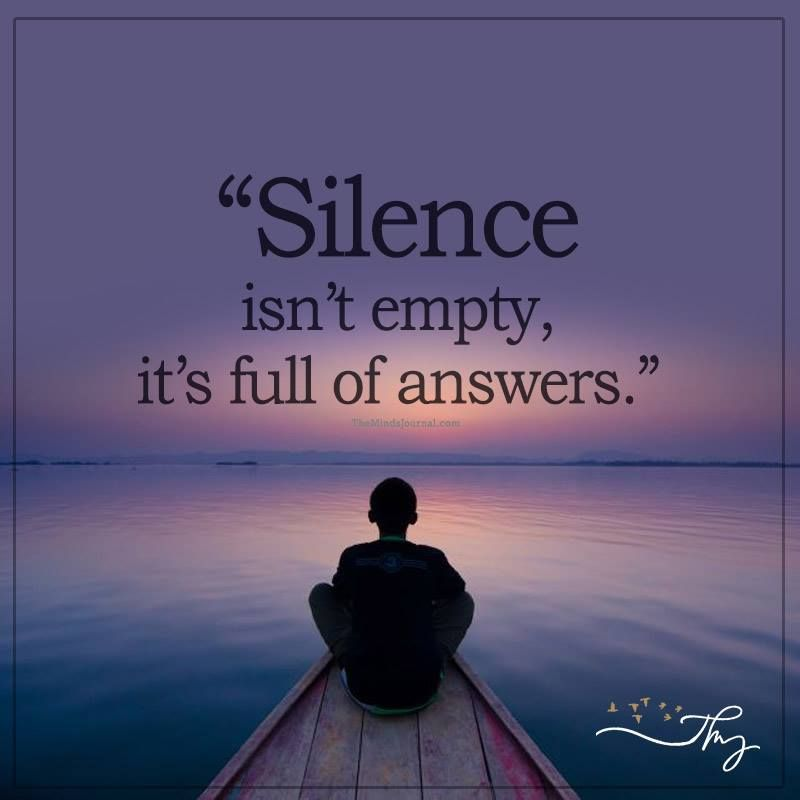
Quaker queries on silence
How do I listen for God?
What happens in the silence?
What does expectant waiting feel like?
Divine Silence
Have you yet learned to live alone?
To search out solitude?
Under great stone nights inside caves
Where those insatiable demons of distraction live?
I once learned to live alone, to open myself up to the dark sky,
To allow myself to be inspected by the stars.
My grandest influence has always been God.
And when I lost God, I knew something huge was missing.
So I cultivated silence in God’s absence.
Nurture this silence. Allow it to expand
As grand as the space between galaxies
Where you become so easy, you alight on star to star.
Your solitude, so vast, you can walk inside yourself
For light years and still you meet no one
Except yourself and your God.
God’s silence can be deafening.
Open your ears to the divine Quiet.
Your Creator cups its hands and whispers your name.
Calls you forth out of death into a new life.
Repeats continuously: Let it be.
Be still, God counsels, and know that I am God.
Be still and know that I am.
Be still and know.
Be still
Be
Author: Our Friend Tony Pfannenstiel (with the permission of Betsy Pfannenstiel)
May 2025

Quaker Queries on Silent Worship
How do I listen for God?
What happens in the silence?
What does expectant waiting feel like?
What are we expecting?
How can I help nurture all of those present in meeting for worship?
How can I prepare my heart, body, and mind before meeting for worship?
Listening in the Silence
Listening is a rare happening among human beings. You cannot listen to the words another is speaking if you are preoccupied with your appearance or with impressing the other, or are trying to decide what you are going to say when the other stops talking, or are debating about whether what is being said is true or relevant or agreeable. Such matters have their right place, but only after listening to the words as they are being uttered.
Listening is a primitive act of love in which a person gives himself of another’s word, making himself accessible and vulnerable to that word.
Author: Marge Abbott
Where The Quiet Dwells
Quiet yourself.
Sit still.
Let life find you there–
Tiny souls like ants and spiders,
Greater ones like squirrels and birds,
The steady ones like trees and rocks.
They come when silence opens the door.
They arrive when you no longer seek.
As a child, I sat on grassy knolls,
In my youth, I wandered for hours
On hills, through wild, rocky paths,
Breathing in the salt of the earth,
Tracing every scent and shadow.
Yet, only in the valley’s mud,
Where the river swelled with restless might,
Did I hear, for the first time,
The mountain’s gentle, hidden song.
In that sound, I heard the world’s own breath,
A rhythm older than my years–
A call to pause, to rest, to trust,
That life would find me if I stayed
Still enough to hear its notes,
Bold enough to walk its way.
Now, when I return to silence,
I hear more than I could before–
The secret song of hidden things,
The murmur of an ancient shore,
Where stillness speaks and water sings,
And I find myself in everything.
Author: Our Friend Tony Pfannenstiel (with the permission of Betsy Pfannenstiel)
April 2025
The Lower Columbia Worship Group will temporarily relocate our meeting so that the library where we normally meet can be remodeled. We will vacate this library sometime in May and will resume meeting in the library sometime in August. More firm dates will be published here as they become apparent. We are currently looking for a temporary meeting space, and that location information will also appear in this space. Visitors will still be able to access our meetings via our Zoom link. 665 200 6460 No password is necessary.

April’s soft whisper, a gentle hush,
Nature awakens with a subtle blush.
From winter’s grasp, the earth does flee,
Embracing warmth, the world feels free.
Petals bloom, the colors they spill,
On every meadow, valley, and hill.
The skies so blue, the clouds so frail,
April’s song, a springtime tale.
Morning dew on the grass so green,
A tranquil scene, so pure, unseen.
April, you bring a world so bright,
Banishing darkness, embracing light.
(Author Unknown)
A Pirate’s Prayer: Walk The Plank
Once, I walked the edge of life’s excess–
Drank too deep, inhaled the world,
Stretched the limits of desire,
Exploring each forbidden shore.
But secretly, I kept a discipline
of brittle forms and shadows,
A crown of dried petals and thorns,
Worn unseen, yet real.
In my aura, a strange piety glowed;
The prayers I whispered in the dark
held back the wolves of doubt.
Candelit vigils, sleepless and raw,
Led me from flesh to ectasy,
yet my spirit, unanchored,
found no harbor in this world.
Now, a gentle space is opening,
it’s air filled with a forgotten calm.
Yet, I remember being a stranger there,
lost, without a guide,
God less a shepherd than a pirate,
raising his half-mast flag
for those of us
who walk the plank at midnight.
Author: Our Friend Tony Pfannenstiel (with the permission of Betsy Pfannenstiel)
March 2025
We’re coming back after refocusing our efforts for the past two months. January and February of this year were hectic and left little time, but this author has been redirected….unfortunately, by the passing of one of our own. Tony Pfannenstiel passed away this month. His ready smile and quick sense of humor will be remembered and missed by all who knew him, but his “being” will continue in his poetry, affecting everyone who reads it. With permission from Betsy Pfannenstiel, I offer below the last piece of his amazing work that he wrote for all of us.

Gravity Defied
Sometimes I want to break free,
unshackle from the earth’s relentless pull,
to feel weightless, soaring high,
my heart swelling like helium,
dancing from star to distant star,
released from the heaviness of living.
This fleeting freedom lifts me up,
a brief superpower, a glimpse of hope
for a life unburdened by worry’s weight–
the endless grind to keep afloat,
to meet the ceaseless demands of life
in this gravity-bound, unyielding world.
I’ve trudged through darkened years,
my worth measured by numbers on paper,
crushed by rejection’s cold, hollow ache,
trying to prove myself, over and again,
as if my very existence required
an endless, weary justification.
Each day, the headlines scream of war,
of shattered dreams and stolen innocence,
a world where power sits on broken backs,
where promises crumble like dust,
and justice whispers through gritted teeth–
no wonder I am bone-deep weary.
I’m tired of religion wielded like a blade,
of faith twisted to feed greed and power,
tired of a world where truth is bought,
where kindness is shadowed by doubt,
and every act of love feels strained,
beneath the weight of a troubled world.
Yet still, I dream of rising above,
to slip from gravity’s merciless grip,
to drift unteathered through a boundless sky,
where laughter floats like seeds in the breeze,
and the sorrow of earth falls far below–
For now, I hold tight to my helium heart,
Dreaming of the day my feet leave this ground,
When I can rise above the wreckage below,
And know, if only for a moment,
What it feels like to truly fly.
Blessings from all of us Tony. Your feet have left this ground as you desired, and we wish you peace for all eternity. FLY Friend Tony.
Fly.
December 2024
Theme for December: Simplicity

“Quaker simplicity is one of the fruits of a primary commitment to the Spirit.”
Writing of simplicity, Thomas Kelly reminds us, “Life is meant to be lived from a center, a divine center – a life of unhurried peace and power. Is it simple? Is it serene?
It takes no time, but occupies all our time.”
(A Testament of Devotion, Pgs 89-100)
Advices and Queries:
Friends are advised to strive for simplicity in the use of their earnings and property, and in their style of living, choosing that which is simple and useful. This does NOT mean that life is to be poor and bare, destitute of joy and beauty.
All that promotes fullness of life and aids in service for the Spirit is to be accepted with thanksgiving. Each must determine by the light that is given what promotes and what hinders our compelling search for inner peace.
Quaker Queries:
Do we each keep our lives uncluttered with things and activities, and avoid commitments beyond our strength and light?
Is the life of our Meeting so ordered that it helps us simplify our personal lives?
Do we order our individual lives so as to nourish our spiritual growth?
(NPYM Faith and Practice Pg 48)
Quaker Comment:
Simplicity is Not about how much stuff we have. It IS about how much importance we give to that stuff.
November 2024
Theme for November: Stewardship
Stewardship is a practice committed to ethical values that embodies the responsible planning and management of resources. The concepts of stewardship can be applied to the environment and nature, economics, health, places, property, information, theology, and cultural resources.
Queries on Stewardship:
1. Do I regard my time, energy, money, and material possessions as gifts to be held in trust and shared according to the light I am given?
2. What do we do as individuals and as a meeting to nurture our gifts?
3. Do I use the world’s resources with care and consideration for future generations and with respect for all life?
Food for thought:
Stewardship is the umbrella idea that promises the means of achieving fundamental change in the ways we govern and behave in our institutions. Stewardship is to hold something in trust for another. Historically, stewardship was a means to protect a kingdom while those rightfully in charge were away, or, more often, to govern for the sake of an underage king. For us, the underage king is the next generation. We choose service over self-interest most powerfully when we build the capacity of the next generation to govern and manage themselves. Stewardship is often defined as the choice to preside over the orderly distribution of power and resources. This means giving people at the bottom and at the boundaries of the organization choice over how to serve a customer, a citizen, or the community. It is the willingness to be accountable for the well-being of the larger organization by operating in service, rather than in control of those around us. Stated simply, it is accountability without control or compliance.
October 2024
Theme for October: Membership

Queries on Membership:
- Do I actively support the meeting community?
- Does my meeting nurture my spiritual growth and transformation?
- Does my participation contribute to the spirit of our worship and understanding?
- Most Importantly…Do I make (F)friends in my meeting?
A Man and His Dog
A man and his dog were walking along a country road. The man was enjoying the scenery when it suddenly occurred to him that he was dead. He remembered dying, and he remembered that the dog walking along beside him had been dead for many years. He wondered where the road was leading them. After a while, they came to a high white stone wall along one side of the road. It glowed like fine marble, so the man and the dog turned in, and at the top of a low rise, they came to a tall arch that glowed in the sunlight.
As he was standing before it, he saw a magnificent gate in the arch that looked like Mother of Pearl, and the street that ran through the gate appeared to be pure gold. He and the dog walked towards the gate, and as he got closer, he saw a man sitting at a desk on one side.
When he was close enough, he called, “Excuse me, but where are we?””This is heaven Sir,” the man answered.”Wow! Heaven! Would you happen to have some water?” the man asked.
“Of course Sir. Come right in, and I’ll have some ice water brought right up. The man gestured and the gate began to swing open. “Can my Friend,” gesturing towards the dog, “come in too?” the traveler asked.
”I’m sorry Sir, but we don’t accept pets.”
The man thought about that for a moment, then turned back towards the road and continued the way he had been going with his dog.
After another long walk, and at the top of another long hill, he came to a dirt road that led through a farm gate that looked as if it had never been closed. There was no fence. As he approached the gate, he saw a man leaning against a tree reading a book.
“Excuse me” he called to the reader. “Do you have any water?”
“Yeah, sure. There’s a pump over there.” The man pointed to a place that couldn’t be seen outside the gate. “Come on in!””How about my friend here?” the Traveler gestured to the dog. “There should be a bowl for him by the pump. Help yourself” They went through the gate, and sure enough, there was an old-fashioned hand pump with a bowl beside it. The traveler filled the bowl and took a long drink for himself, and then he turned over the bowl to the dog who lapped greedily. When they were both full, he and the dog walked back towards the man who was standing by the tree waiting for them.
“What do you call this place?” the traveler asked.”This is Heaven”, was the answer.”Well that’s confusing,” the traveler said. The other man down the road said that was Heaven too”.”Oh you mean the place with the gold street and the pearly gates? Nope. That’s Hell.”
“Doesn’t it make you mad for them to use your name like that?”
“No. I can see how you might think so, but we’re just happy that they screen out the folks who would choose to leave their best friend behind.”
Original Author unknown
Kids see it Differently:
- Sometimes I don’t like the people I love. Alice, 4yo.
- Anyone can be a family. You just have to love each other and feed each other. Anonymous 6yo.
- Did you know that sleeping is the body’s way of telling other people to go away? Lachlan 4yo.
- Parmesan cheese is like glitter for your spaghetti! Callum 4yo
- My soul is telling me I want pizza. Saddie 6yo.
September 2024
Theme for September: Integrity

“There are several different ways to consider the idea of integrity. When Quakers have to make important decisions, we often use “clearness committees” to challenge and test the integrity of the possible solutions for that particular problem. Below is a more complete description of the “clearness committee process.”
In a clearness process, an individual (or couple, in the case of clearness for marriage) meets with three or four other Friends in a spirit of worship, listening, and loving concern. The clearness committee’s job is to help the focus person discover whether there is clarity to move forward with a matter, wait, or take other action. Clearness committees can be used informally as a way of testing for clarity around personal decisions or transitions, and more formally for membership, marriage, public ministry, witness, or the carrying of a concern that ought to be brought formally into our meetings’ care and accountability. In the formal clearness process, this clarity is also for the spiritual community. If a recommendation is to be brought before the community, clearness must be sought on behalf of both the meeting and the individual.
The clearness process includes:
–Worshiping together
–Deep listening to the questions & concerns brought to the committee
–Careful, gentle open-ended questions from clearness committee members
–Reflecting back on what has been heard.
Quaker Queries on Integrity:
- How do I strive to maintain the integrity of my inner and outer lives?
- Do I act on my principles even when this entails difficult consequences?
- Am I honest and truthful in all that I say and do, even when compromise might be easier or more popular?
- Am I reflective about the ways I gain my wealth and income and sensitive to their impacts on others?
- As we seek unity, do we listen to one another carefully and with openness to Truth?
- Are we able to express our views honestly and with respect for those who differ with us?
- Are we prepared to set aside our individual desires or opinions in order to reach unity in the divine Light?
Sometimes “Integrity” takes a more comical turn:
Two boys were misbehaving… …so their mother went to her Pastor for advice. The Pastor thought it would be best if the boys learned integrity, by way of understanding that “God is everywhere, and He sees everything you do so you shouldn’t misbehave.”
The mother and the Pastor thought it best that the Pastor talk to the boys, so the mother agreed to take the boys in one at a time to talk to the Pastor’s office.
She brought the first boy (Ray) to the church and left the second boy (Jim) at home. She took Ray into the Pastors’s office and stayed outside while the Pastor and Ray talked.
“Where is God?” The Pastor calmly asked expecting to make the point that “God is everywhere”. Ray, petrified, said nothing. So the Pastor asked again slightly louder, “Where is God?!”. Ray still said nothing. So the Pastor stood up and slammed his hands on the desk yelling, “WHERE IS GOD?!?!”. Ray jumped up and ran out of the office, flew past his mother, and ran all the way home.
He came screaming in the front door and ran straight to his brother Jim’s room. He opened the door and said, “GOD IS MISSING AND THEY THINK WE TOOK HIM!”.
August 2024
Theme for August: Education and Spiritual Development
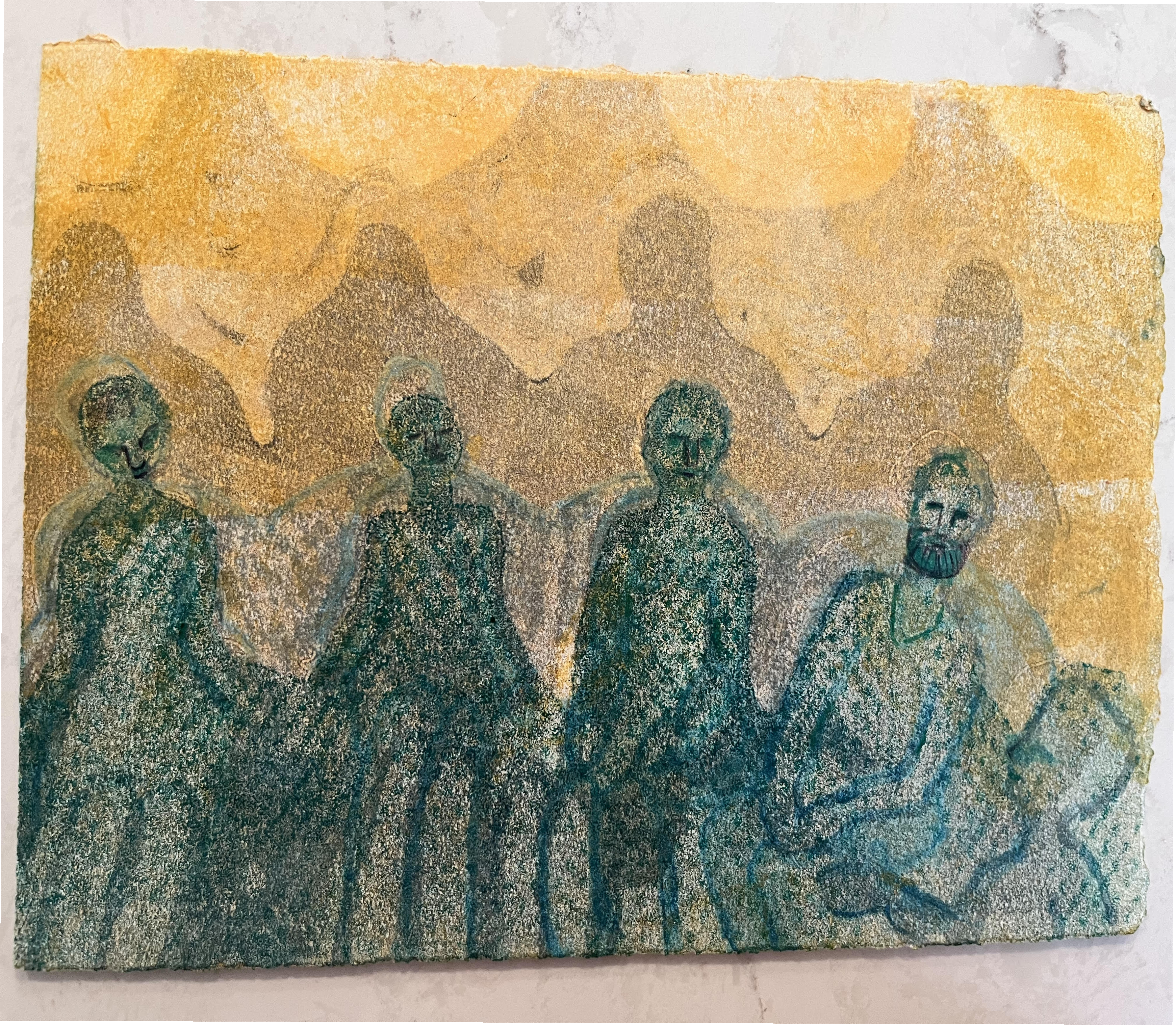
Artwork contributed by Friend Elizabeth Zimmerman with permission to reproduce for this purpose. Thank you, Elizabeth for your work.
Quaker Queries on education and Spiritual development.
- Do I make time for meditation, prayer, and worship?
- What efforts can I make to better acquainted with Quaker faith and practices?
- How do I prepare to play an active role in a changing world?
Basic Quaker Beliefs:
- There is something of the divine in all of us, and each person is of unique worth.
- All people are valued equally, and anything that may harm or threaten them is opposed.
- Religious truths are sought in inner experience, and conscience is the basis of morality.
Biblical Reference: Proverbs 16:16 NIV
“How much better to get wisdom than gold. To get insights rather than silver.”
Spiritual Growth
The most important spiritual growth
doesn’t happen when you’re meditating
on a yoga mat.
It happens in the midst of conflict……
when you’re frustrated, angry, or scared,
and you’re doing the same old thing.
And then you suddenly realize that
you have a choice to do it differently.
Special event: On Sunday, August 25th, 2024 we will be hosting an opportunity to learn more about Quaker Worship Sharing. Barb Leedy from Portland will be guest hosting a meeting for worship with a concern for learning, and we will have an opportunity to learn about that time-honored tradition.
Please join us either in person or on Zoom at 11:00am. Also…..please click on the “NEWS AND EVENTS” tab on the main page for more information.
Our Zoom link for that day is 867 9256 3988 If prompted, the Password is 450163
July 2024
Theme for July: Caring For One Another

Quaker Queries on Caring For One Another:
- In what ways do I show respect for that of God in every person?
- How do I reach out to those with special needs?
- How do we recognize and affirm spiritual gifts in our community?
Biblical References:
Romans 13:9-10 New International Version 9 The commandments:
“You shall not commit adultery,” “You shall not murder,” “You shall not steal,” “You shall not covet,”[ a] and whatever other command there may be, are summed up in this one command: “Love your neighbor as yourself.”[ b] 10 Love does no harm to a neighbor.
Quakers have a long tradition of calling each other “Friends”. This tradition comes from the Bible and specifically tells us how deeply we should care for each other.
John 15:13 Greater love has no one than this: to lay down one’s life for one’s friends
This Is It
This is it
This is really it
This is all there is
and it’s perfect as it is
There is nowhere to go
but Here
There is nothing here
but now
There is nothing now
but This
And this is it
This is really it
This is all there is
And it’s perfect as it is
Reprinted with full credit to James Broughton for his work.
Some people care too much. I think it’s called LOVE!
Winnie the Pooh
June 2024
Theme for June: Diversity

We must not only learn to tolerate our differences. We must welcome them as the richness and diversity which can lead to true intelligence.
Albert Einstein
Preservation of one’s own culture does not require contempt or disrespect for another culture.
Cesar Chavez
Quaker Queries on Diversity:
- How well do I work towards creating a community of different people, rather than a community that just lets different people in?
- Are we willing to be in communion with each other, open to our differences, yet secure in the one Spirit that calls us all to be Friends?
- Do I seek out and listen to perspectives that promote equal access, inclusion, and welcome for people of all cultures and backgrounds?
I Am Diversity
I Am Diversity, Please Include Me
I‘m present in every place you go
Depending on your lens I’m friend or foe
I’m a force to be reckoned with
Like the winds of change, I move. I’m swift.
I’m present when two or more are together
If embraced I can make the good even better.
I’m not limited to age, gender, or race.
I’m invisible at times and yet all over the place.
Don’t exclude me due to a lack of knowledge
Welcome me like the recruit fresh out of college.
Let me take my seat at the table
Even though I may be differently able
My experience, my passion, the authentic me
can help add value for your company.
Learn about me; improve my underrepresentation
And I can provide a competitive edge to your entire nation.
I exclude no one I am strengthened by all
My name is Diversity and yes I stand tall.
Recognize me and keep me in the mix
Together there’s no problem that we can’t fix.
I am your best hope towards true innovation
And to many, I reflect hope and inspiration.
Your lives and companies will continue to change
Thus the need for Diversity and Inclusion will also remain.
Do all that you can to truly embrace me
And experience life’s fullness totally
I’m the thought lurking behind the unfamiliar face
I’m the ingenuity that helps your team win the race.
I’m the solution that came from the odd question that was asked.
I stand out in the crowd when I, Diversity, am allowed to be unmasked.
I’m diversity. Embrace me and we’ll journey far.
I’m Diversity. Include me and we will reach the shining star.
Coupled with Inclusion our lights burn longer
Together we are smarter, better, and stronger
I am Diversity
Yes, that’s me
With full and grateful credit to Charles Bennafield, A Pastor and Poet located in Georgia, USA.
A diversity practitioner with an extensive background. Also available as a video. (See below).
https://www.facebook.com/watch/?v=464857788083298
May 2024
Theme for May: Equality
Part II. We seek a society with equality and justice for all.
What doth the LORD require of thee, but to do justly, and to love mercy, and to walk humbly with thy God? (Micah6:8
Quote from: The World We Seek. A publication of FCNL representing
the views of the Religious Society of Friends.
Friends’ witness calls for right relationships among people and between individuals and God. Governments are instituted, in part, to promote and protect basic human rights. These are rights, not mere privileges subject to easy denial. Friends acknowledge the indispensable role of government in safeguarding the integrity of our society and the essential dignity of all human beings. Citizens have the responsibility to participate vigorously in making government more responsive, open and accountable.
Separate – But Equal
Stationary in open space is the usual,
common, the with-standing. That’s all there is.
Nothing’s misunderstood. The chairs, that table,
the white salt shaker, that black pepper shaker,
separate – but equal.
Nothing’s misrepresented;
nothing’s misunderstood
Soon seated is a white woman and a black man.
Stationary in open space is the unusual,
common, the out-standing. That is not all there is.
Everything’s misunderstood. The seating, that table,
the white woman , that black man–
separate, but equal.
Everything’s misrepresented;
everything’s misunderstood.
Reprinted with the permission of the Author, Emmett Wheatfall from his book “As Clean as a Bone” (2018). As a friend of (F)friends, we honor his work. Thank You for your words.
Suggested reading from our lending library:
“Black Fire”
Edited by Harold Weaver, Jr.; Paul Kriese; and Stephen W. Angell
“Waking Up White”
By Debby Irving
“As Clean as a Bone”
By Emmett Wheatfall
“The World We Seek”
By FCNL
Special Announcement:
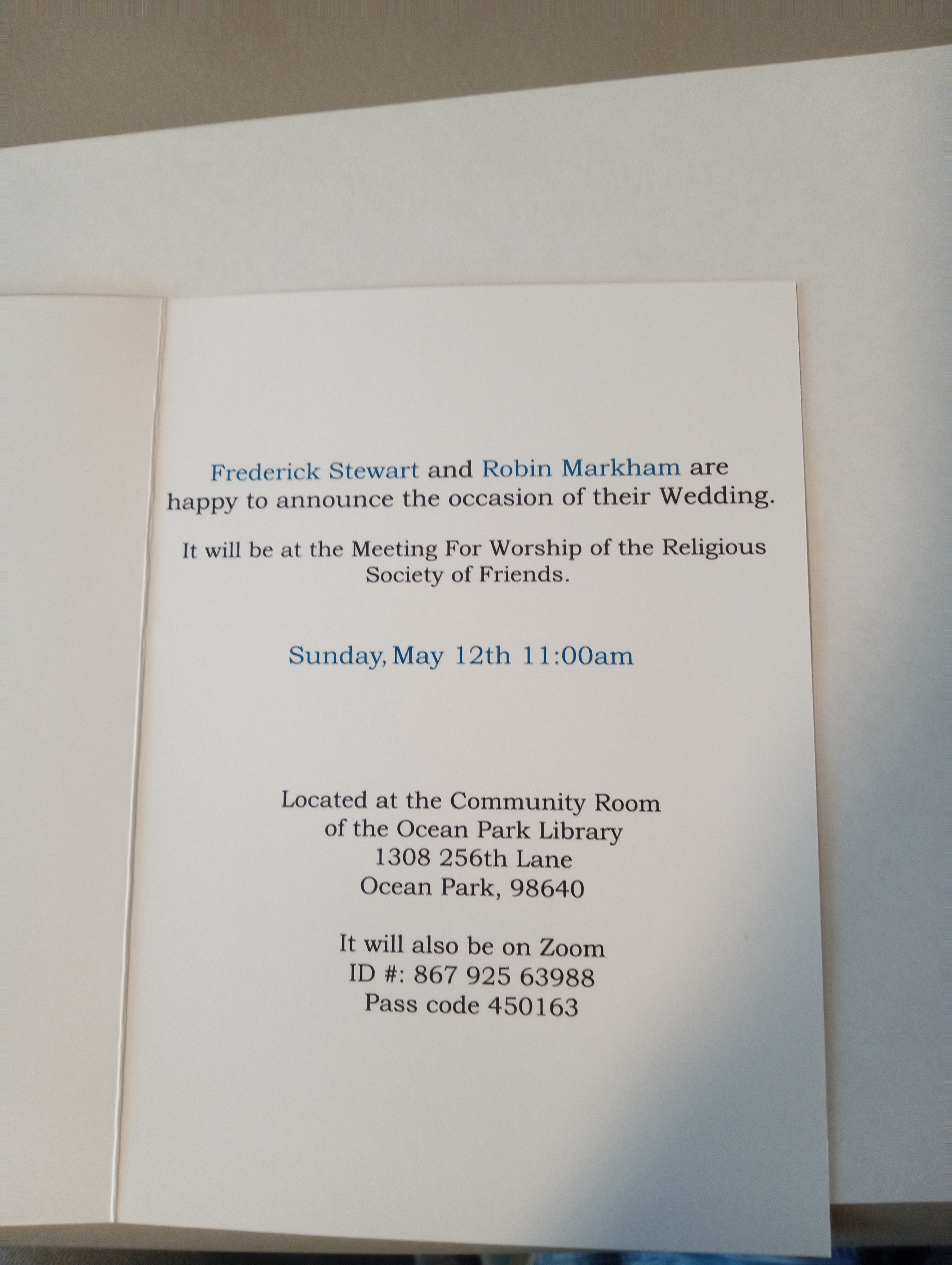
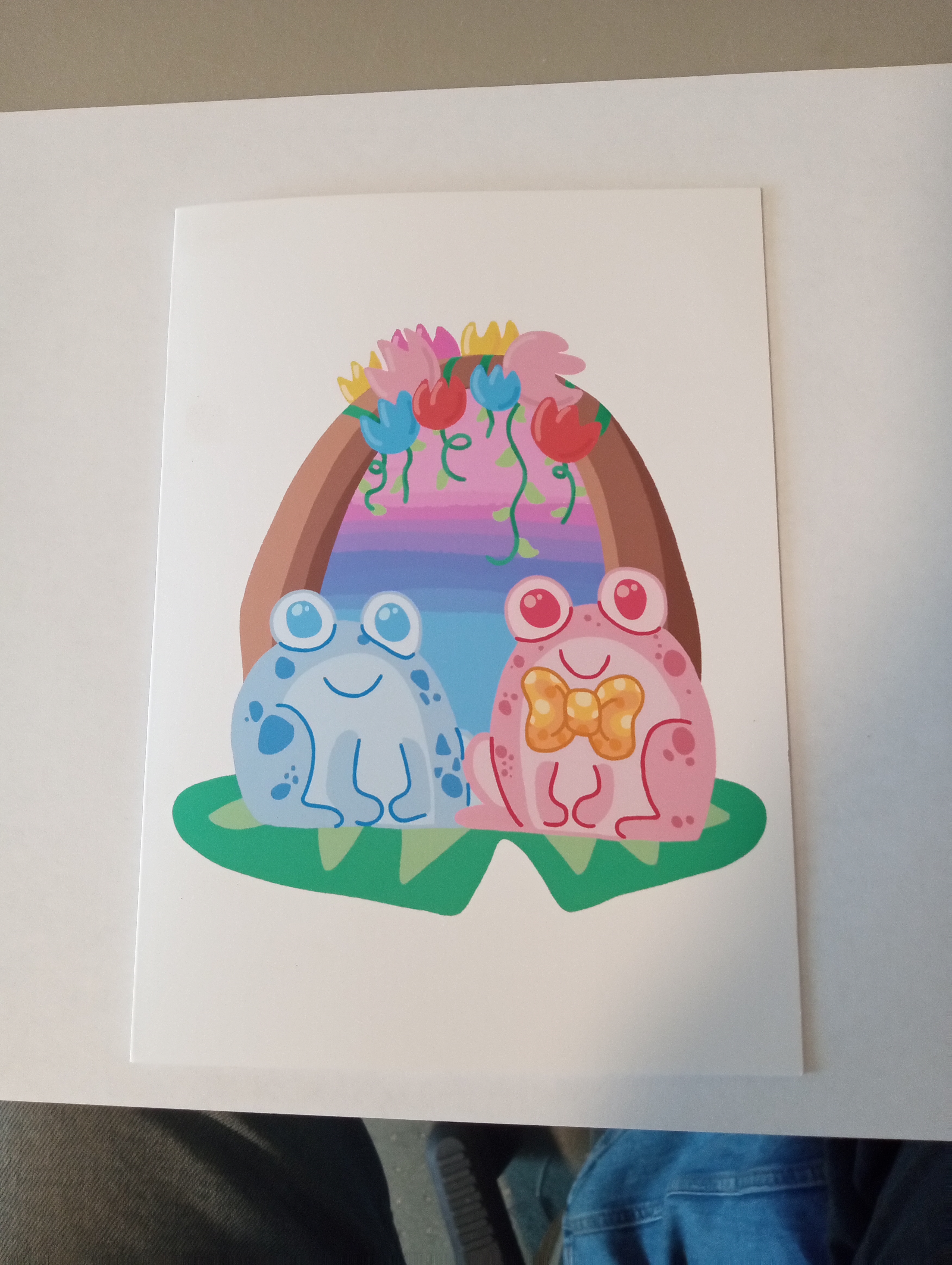
We have a special celebration scheduled for this month. Two of the members of our group
will be celebrating their wedding with us on Sunday, May 12th, and we are proud to be part of that event.
April 2024
Theme for April: Peace and Social Concerns
(Artwork courtesy of Elizabeth Zimmerman)
Quotes:
Peace
Peace. It’s not about silence. It’s not a place without troubles or fears. Peace is standing in the middle of chaos, and finding calm in your heart.
(Author unknown)
Queries:
1. How does my life reflect “The virtue of that life and power which takes away the occasion of all war?”
2. Where hatred, division, and strife exist, how may I bring peace and understanding?
3. As I work for peace, am I nourished by peace within myself and within the meeting?
Imagine:
Imagine there’s no heaven
It’s easy if you try
No hell below us
Above us, only sky
Imagine all the people
Sharing for today, ha, ah, ah
Imagine there’s no countries
It isn’t hard to do
Nothing to kill or die for
No religion too
Imagine all the people
Living life in peace, you
You may say I’m a dreamer
But I’m not the only one
I hope some day you’ll join us
And the world will be as one
Imagine no possessions
I wonder if you can
No need for greed or hunger
A brotherhood of man
Imagine all the people
Sharing all the world, you
You may say I’m a dreamer
But I’m not the only one
I hope some day you’ll join us
And the world will be as one
(Author John Lennon)
Spring Manual
(Courtesy of Stephanie Van Horn)
“Heel in the rose,” the package says,
directions for each action,
even the simplest filling
of the world with parts of itself.
Mix compost, peat moss,
original dirt kept like a favorite jacket.
Even the wind follows directions,
north changing to south.
Sit with me.
At this angle of light,
we have run out of winter:
The empty jar gleams.
Teaching the neighbor’s girl colors,
matching her eyes and crocus,
butter and daffodil,
copper pot, caterpillar,
we search daily
for more instruction—-
simple words,
spring.
March 2024
The e-mailing of our newsletter each month has been suspended in favor of posting ideas and events on this webpage. Please look here in the future if you would like to know what we’re up to here on the peninsula.
As a group, we will be selecting a new theme for each month complete with some queries to help us all focus on that theme, and we intend to accompany those queries with poetry, personal thoughts, and contributions by those who attend our meeting. With that said, March 2024 carries the theme: Vocal Ministry and Listening
Queries:
- How do I discern when to speak and when not to speak, both in meeting and elsewhere?
- How do I practice listening to the Truth which may be revealed by others?
- How have I been changed by deeply listening to another, to God, and to nature?
Matins
The morning waits, listens
for the daily wind to rise,
birds among dark leaves
the only ripple on the day’s smooth surface.
Any word could become a bell,
first tinsel chiming, then swelling
to hold this clearing,
the fir ridge, the town beyond.
Any possibility could name itself and be born.
A foot could be set right,
a certain luck could occur,
a dark stranger could stand at the door waiting.
Luck all year.
We could, the whole human family,
stand in relation to each other,
join hands under the canopy of the bell’s sound.
And sometimes — our shells as hard
as the hazelnuts the squirrel pursues —
sometimes we open the fragrant meat of ourselves
to a lucky glance, the stuttering confidence.
A hand on another hand and the whole body is dignified,
stands healed and solid in the open air.
Luck. The grace of the stumble arrested,
of rising again under this quiet sky.
A bright door opens to the friendly room beyond.
A great bowl, sweet dough there on the counter,
waits to be shaped.
The window
frames what I see,
the forest of possibilities.
I am grateful now,
calling my luck by its right name.
Upstairs, someone is sleeping.
Love. Hear how it sounds.
Poetry contribution courtesy of Stephanie Van Horn 2024
February 2024
February, among other things, is noted as black history month. There is quite a bit of discussion going on about the more well-known black leaders and others who have supported the civil rights movement, but there have been many who spent their time in the trenches; supporting the more well-known personalities. Vincent Harding was one of those who contributed so much with very little recognition.
Vincent Harding
Vincent Harding (1931-2014), was a theologian, historian, and nonviolent activist. Even though he was not a Quaker, he was a friend of the community and affiliated with the Pendle Hill Quaker Retreat Center. Harding and his late wife, Rosemarie Freeney Harding, worked as negotiators in the Southern Freedom Movement in the ’60s and were friends and co-workers with such leaders as Martin Luther King Jr., Ella Baker, Fannie Lou Hamer. (Harding provided the initial draft for King’s “Beyond Vietnam” speech at Riverside Church in New York City.) Harding was one of the organizers and the first director of the Institute of the Black World, founded in Atlanta in 1969. After holding several research positions and visiting professorships (including two years on the staff of Pendle Hill), he served as professor of religion and social transformation at the Iliff School of Theology in Denver for nearly a quarter of a century and served as professor emeritus and trustee at Iliff.
“You can’t start a movement, but you can prepare for one.“
— Vincent Harding
January 2024
February is rapidly approaching, and here on the Long Beach Peninsula, the long days of rain and ice we have had recently are starting to take a toll, so…following some good advice about adding some humor to counteract the grayness…please find below some comments that have been heard from children in various churches. Kids are always surprising.
Why do Brides Wear White?
Attending a wedding for the first time, a little girl whispered to her mother, “Why is the bride dressed in white?”
The mother replied, ‘Because white is the color of happiness, and today is the happiest day of her life.’
The child thought about this for a moment then said, “So why is the groom wearing black?”
Running To Church
A little girl, dressed in her Sunday best, was running as fast as she could, trying not to be late for Bible class. As she ran she prayed, ‘Dear Lord, please don’t let me be late! Dear Lord, please don’t let me be late!’
While she was running and praying, she tripped on a curb and fell, getting her clothes dirty and tearing her dress. She got up, brushed herself off, and started running again!
As she ran she once again began to pray, ‘Dear Lord, please don’t let me be late…But please don’t shove me either!’
My Dad Makes Big Money
Three boys are in the school yard bragging about their fathers. The first boy says, ‘My Dad scribbles a few words on a piece of paper, he calls it a poem, they give him $50.’
The second boy says, ‘That’s nothing. My Dad scribbles a few words on piece of paper,
he calls it a song, they give him $100.’
The third boy says, ‘I got you both beat. My Dad scribbles a few words on a piece of paper, he calls it a sermon, and it takes eight people to collect all the money!’
Travel Plans
A Sunday School teacher asked her class why Joseph and Mary took Jesus with them to Jerusalem . A small child replied, ‘They couldn’t get a baby-sitter. ‘
Applying the 10 Commandments
A Sunday school teacher was discussing the Ten Commandments with her five and six year olds. After explaining the commandment to ‘Honor thy father and thy mother,’ she asked, ‘Is there a commandment that teaches us how to treat our brothers and sisters?’
Without missing a beat, one little boy answered, ‘Thou shall not kill..’
Adam’s Ribs
At Sunday School they were teaching how God created everything, including human beings. Little Johnny seemed especially intent when they told him how Eve was created out of one of Adam’s ribs.
Later in the week his mother noticed him lying down as though he were ill, and she said, ‘Johnny, what is the matter?’Little Johnny responded, ‘I have pain in my side. I think I’m going to have a wife.’
August 2023
As we are about to enter the month of August, when peridot is the traditional
birthstone. The beautiful weather somehow makes it feel right to have some discussion
around laughter and humor. Here at the beach where summer times are so beautiful,
and where we have multitudes of tourists, we often hear children laughing and playing
in the ocean, or around the attractions in our towns, so it seems appropriate to look at
the science of laughter, followed up by some thoughts about humor as seen through the
eyes of children.
Please enjoy these “Letters To God” in the spirit they are intended. Credit for content is
provided where available.
Blessings,
Al H. Clerk
LCWG
LAUGHTER AS MEDICINE
It is said that young children laugh as much as 100 to 200 times a day, compared to a large
majority of adults who only get in zero to maybe a few daily laughs. Yet laughter is good not only
for the body but also for the soul and Spirit.
An Internet site advises this Wellness Tip: “Go on and laugh! Whether your preference is giggle,
chuckle or guffaw, here are a dozen well-being benefits of laughter: Increases antibodies in saliva
that combats upper respiratory infections. Secretes an enzyme that protects the stomach from
forming ulcers. Conditions the abdominal muscles. Relaxes muscles throughout the body. Aids in
reducing symptoms of neuralgia and rheumatism. Changes perspective. Has positive benefits on
mental functions. Reduces blood pressure and heart-rate. Helps the body fight infection. Releases
endorphins which provide natural pain relief. Tightens stomach muscles. Helps move nutrients and
oxygen to body tissues. AND, it makes you feel good!
CHILDREN’S LETTERS TO GOD
These charming items are often circulated as an anonymously written piece; but they are actually
excerpts from a lovely book by Stuart Hample & Eric Marshall, Children’s Letters to God (Workman
Publishing, 1991 and reprints); here are a few sample messages:
Dear God, I read the Bible. What does begat mean? Nobody will tell me. Love, Allison.
Dear God, Instead of letting people die and having to make new ones, why don’t You keep the
ones You already have now? Jane.
Dear God, Maybe Cain and Abel would not have killed each other if they had their own rooms.
That’s what my Mom did for me and my brother. Larry.
Dear God, If You watch me in church on Sunday, I’ll show You my new shoes. Mickey.
Dear God, I bet it is very hard to love everyone in the whole world. There are only 4 people in our
family and I’m having a hard time loving all of them. Nan.
Dear God, Are You really invisible or is it just a trick? Lucy.
Dear God, Did You mean for the giraffe to look like that or was it an accident? Norma.
Dear God, I went to this wedding and they kissed right in the church. Is that OK? Neil.
Dear God, Did You really mean “do unto others as they do unto you”? Because if You did, then I’m
going to get my brother good. Darla.
Dear God, Thank You for the baby brother, but what I prayed for was a puppy. Joyce.
Dear God, I think about You sometimes, even when I’m not praying. Elliot.
Dear God, My brother told me about being born but it doesn’t sound right. They’re just kidding,
aren’t they? Marsha.
Dear God, I didn’t think orange went with purple until I saw the sunset You made on Tuesday.
That was cool. Eugene.
AUGUST QUERIES
Courtesy of Friends Journal, November 26, 2018
http://www.friendsjournal.org/writing-opp-humor/
1: How can we use humor to come closer to God and our fellow humans?
2: What role does humor have in our worldly outreach?
3: What kind of humor would Quaker humor be…..if we were more humorous?
May 2023
Transformation
May typically begins a season of transformation in our area. Change is evident in all the trees and plants, as well as in all the new baby animals that co-exist with us. The rain is finally beginning to give way to more warm and sunny days, and there is a certain joy in all the obvious physical transformations.
The opportunity for transformation of a spiritual nature through story telling is also a possibility, and so beginning in May, certain attenders of the Lower Columbia Worship Group who feel led to participate will begin telling the stories of their individual spiritual journeys and how those journeys led to their own spiritual transformations.
This is the second time our Worship Group has invested our time and energy into spiritual story telling, and we are repeating this work because we see the value in getting to know each other more fully and deeply.
Queries to help guide our discussions on Transformation:
- 1. In what ways am I experiencing (or do I long to experience) transformation in myself, my work, my community and the world at large?
- 2. How am I feeling led to seek transformation?
- 3. What role does transformation play in my story?
- 4. Do I understand my spiritual journey as a process of transformation?
April 2023
The Universalism of Early Friends
It is sometimes thought that the Christian and universalist themes in Quaker faith
and experience are in contention with each other. But this is a misunderstanding of the
true situation. … The universalist insight that has characterized the Quaker movement
from its very beginning was rooted in Friends’ understanding of Christianity itself. Early
Friends were not, in general, widely traveled, so they had not had the opportunity to meet
people of holiness who were Hindus, Buddhists, or Muslims, as we so easily do
nowadays. Nor were they able to down to … a bookstore and pick up a copy of the
Bhagavad Gita or the Dammapada for a few dollars.
It is true that one Friend, Mary Fisher, went to see the Sultan of Turkey. It is also
true that George Fox demonstrated the universality of the Light to a colonial governor in
America by discoursing with a Native American. But these were relatively isolated
cross-cultural encounters in the late 1600s. For the most part, the universalism of early
Friends was derived from their understanding of Christian scripture as read with guidance
of the Holy Spirit
The Quaker idea that there is a Christ-spirit in all people which could lead to
Truth, even if they never heard of Jesus … was not the only reason why Friends were
persecuted by other Christians, [but] it was one key provocation.
In modern times, mainstream Christianity has been much weakened by secular and
technological culture. Nevertheless … [It] survives strongly enough to do some
destructive work. It tends to advance the idea of a finger-wagging Deity seeking
vengeance, or atonement, and prepared to punish us if our performance does not measure
up. . . [This] sort of religion can be spirit-killing, cruel, and traumatizing.
Not surprisingly, such traumatized people who still seek a spiritual path can come
to find a refuge in Quakerism. . . Now the experience of refugees from Christian
malpractice is quite authentic and must be honored. I consider myself to be such a
refugee. But it seems to me that the overall state of affairs leaves the corporate body of
Friends trying to cobble together a shared spiritual life bereft of any of the poetry, the
metaphors, and the ideas which our civilization has developed to address the profound
and elusive mysteries of spiritual experience. We are left trying to explore and express a
common faith using only such vocabulary as one might hear in a public-school
classroom.[All] the major religions have their shadow side; Christianity is hardly unique
in that regard. So, a true Quaker universalist will be wary of tendencies which seem bent
on excising Christian vocabulary and Christian thought-forms from contemporary Quaker
culture, just as he or she will be wary of an intolerant Christian dogmatism which might
seek to infect the Religious Society of Friends. – Daniel A. Seeger (2000).
One voice from among many quoted in the Western Friend Newsletter February 11, 2023.
The Quaker Universalist Fellowship
The Quaker Universalist Fellowship (QUF) was founded in 1983 by a group of
concerned Quakers interested in the experience of the Quaker Universalist Group in
Britain Yearly Meeting, and who wished to re-emphasize three revolutionary beliefs held
by 17th century Friends (Quakers): There is “that of God” in every person; This is best
explored with other seekers in meetings for worship; No other leadership is needed
except the Divine Spirit within.
Global Meeting for Worship (GMFW)
Live silent online Quaker worship hosted by Quaker Universalist Fellowship (QUF)
Wednesdays @ 11 AM-12 PM Pacific Time
For more information, or to receive a link to the Global Meetings for Worship,
contact: GMFW@universalistfriends.org.
March 2023
Reaching Decisions
Friends approach to making decisions about matters of concern has deeper roots
than those methods used in other organizations. Most of us are familiar with Roberts
Rules of Order. That manual of parliamentary procedure, written by Henry M. Robert,
was first published 1876. In contrast to reaching decisions by voting, Quakers have
continued since the mid 17th century to seek Unity through discerning the Spirit’s will for
the body as a whole. Another contrast to Quaker process is the practice of “consensus”.
Consulting the Oxford English Dictionary [The Shorter Oxford Dictionary on Historical
Principles], the earliest citation for consensus is from 1854. A wonderful thing
consensus, yet that is not Quaker process. So how are decisions made in a Friends
Meeting? A description from Philadelphia Yearly Meeting’s Faith and Practice 1972
might provide a flavor of the process:
“Meetings for the transaction of business are conducted in the same expectant
waiting for the guidance of the Spirit as is the meeting for worship. Periods of worship,
especially at the beginning and end, lift hearts and minds out of self-centered desires into
an openness to seek the common good under the leadership of the Spirit of Christ. All
matters are considered thoughtfully, with due respect to every point of view presented.
When a course of action receives the general, though not necessarily unanimous,
approval of the group, the presiding clerk formulates the sense of the meeting and it is
recorded in the minutes. No vote is taken; there is no decision made by a majority, who
override opposition. Action is taken only when the group can proceed in substantial
unity.”
N
Note that the decision is not necessarily unanimous. In the case of a weighty
decision, for instance changing the time or place for meeting, a person with a strongly
held objection can ask to be minuted as standing aside. Then attention to further business
matters can proceed.
The emphasis of a meeting for business is on the process. Following is guidance
from Paul Lacey in his essay “Some Thoughts on Quaker Process”:
- Integrity of community is more important than quick, or efficient, or right decisions.
- There is no rush to decide things, since the process is in God’s hands.
- Coming into a business meeting with one’s mind made up, even if one is right, is
unfaithfulness to the process. - The primary aim of the business meeting is to deepen the spiritual life of the
community, rather than getting things done.
Since this Bulletin is bathed in quotes and extracts, your correspondent will
continue with some practical suggestions for participating in a Meeting for Business from
Bill Taber:
- Get to meeting early and settle into worship as soon as possible.
- Absorb as well as hear the words spoken, and bathe the speakers and clerk in wordless
prayer. - Wait for the deep inward motion, which is deeper that a surface emotion or idea; and
then, before speaking, wait to see if Love is also there. - Stay in worship, in a special state of consciousness. In a wider, softer mind, a
nonreactive mind, a quieter mind, thinking can be even keener; our thinking does not
get in the way of feeling, of waiting for leadings. - Recognize the value of the spaces in meeting. There needs to be enough space
between messages and minutes to reconnect with a deep underlying unity beneath and
beyond words, even when we seem to have a strong disagreement on the level of
words. - When there is disagreement, be prepared for the process to pause long enough for God
to reveal a new, more creative perspective. - Do not be afraid to say no. That can be an obligation.
On a recent Sunday (First Day in antiquated speech) five attenders of our worship
group visited Olympia Friends Meeting. Olympia Friends had moved their meeting time
an hour later to accommodate our travel time and provide lunch thereafter. One of their
regular attenders commented toward the close of the visit that Olympia had the greatest
number at the meeting than they have had for some years. Your correspondent suspects
that might not have been due to our radiant personalities, rather it was, among other
factors, the beneficial nature of visitation among Friends.
And the end of words is to bring men to the knowledge of things beyond what words can
utter. Isaac Penington (1616-1679)
February 2023
Visitation
On a recent Sunday (First Day in antiquated speech) five attenders of our worship
group visited Olympia Friends Meeting. Olympia Friends had moved their meeting time
an hour later to accommodate our travel time and provide lunch thereafter. One of their
regular attenders commented toward the close of the visit that Olympia had the greatest
number at the meeting than they have had for some years. Your correspondent suspects
that might not have been due to our radiant personalities, rather it was, among other
factors, the beneficial nature of visitation among Friends.
An example from Britain Yearly Meeting’s Quaker Faith & Practice:
At the very small recognised meeting where I am a member – we have been as few as two
at meeting for worship – we welcome visitors from other meetings, whether casual or
regular, and look upon them as a source of enrichment. We understand that we in turn
can give from our quietly gathered meeting. Ingrid Williams, 1994
Letter of Introduction
For those who travel, particularly outside the immediate area, it may be useful to
ask for a letter of introduction. It can be a way to open doors to local gatherings, help to
establish interconnections between your home meeting and those you are visiting.
We urge Friends, when staying away from home during holiday or on business, to
attend a meeting for worship if there is one within reach. Such attendance may well have
the effect of strengthening the meeting, and of helping Friends who were hitherto
strangers to know one another. Britain Yearly Meeting Quaker Faith & Practice.
The letter, signed by the clerk, gives some information about the traveller’s participation
in our Religious Society and express such greetings as may feel to be suitable. The letter
is usually endorsed by the clerk of the meeting visited. That letter is returned` to the local
group along with the visitor’s reflections on their visit.
Traveling in the Ministry
One of the most useful services to our Religious Society has been provided by
those Friends who feel called to share concerns through religious visits to families, public
addresses, or specially arranged meetings for worship or other similar religious service.
Those so called are usually seasoned members and their call to service is subject to
discernment, which is well described in North Pacific Yearly Meeting’s Faith and
Practice. Another comment from Britain Yearly Meeting’s Quaker Faith & Practice:
For over 35 years I have been visiting meetings other than my own. For the last 15 years
monthly meeting has given me a travelling minute which is returned annually with its
endorsements. I have visited the smaller meetings in my own monthly meeting; I have
visited nearby meetings in other monthly meetings and thus kept contact with neighbours
who might easily be strangers; when further from home I have sought out smaller
meetings which might be encouraged by a visitor, and I am sure that the two or three
present have been so encouraged. I have attended special occasions such as the
reopening of a refurbished meeting house and rejoiced with those who rejoiced.
Richard Schardt, 1994
An extract from John Woolman’s Journal offers a clear description of the steps
taken to obtain a traveling minute:
Having been some time under a religious concern to prepare for crossing the seas in
order to visit Friends in the northern parts of England, and more particularly in
Yorkshire, after weighty consideration I thought it expedient to inform Friends at our
monthly meeting in Burlington of it, who, having unity with me therein, gave me a
certificate. And I afterwards communicated the same to our quarterly meeting, and they
likewise certified their concurrence. Some time after, at the General Spring Meeting of
Ministers and Elders, I thought it my duty to acquaint them with the religious exercise
with attended my mind, with which they likewise signified their unity by a certificate,
dated the 24th of third month 1772, directed to Friends in Great Britain.
For further reading: John Woolman. Journal and Major Essays of John Woolman.
Phillips P. Moulton, ed. Oxford University Press, 1971.
January 2023
Imaginary Friends
George Fox observed (in the 17th century) because “Friends could not put off their
hat to people, nor say you to a particular person, but thee and thou; and could not bow,
nor use the world’s salutations nor fashions nor customs . . . people would not trade with
them nor trust them. And for a time [Quakers] that were tradesmen could hardly get
money enough to buy bread, but afterward when people came to see Friends’ honesty and
truthfulness and “yea” and “nay’ at a word in their dealing, and their lives and
conversations did preach and reach to the witness of God in all people, and they knew
and saw that they would not cozen and cheat them for conscience sake towards God:—
and that at last they might send any child and be as well used as themselves at any of
their shops, so then the things altered so that all the inquiry was where was a draper or
shopkeeper or tailor or shoemaker that was a Quaker: then that was all the cry, insomuch
that Friends had double the trade beyond any of their neighbors.”
Honesty and integrity in business enterprises benefited Friends. That reputation
led to appropriating the image and reputation of Friends for the profit of businesses with
no relationship with Quakers, hence Imaginary Friends. A few instances follow.
We really must start out with coffee. Lee & Caddy’s Quaker Coffee does not
appear to be on the market nowadays.

There is no trademark protection for the term “Quaker”. Some Friends have tried
to have commercial enterprises drop its use, to no avail.
The Quaker reputation for thrift may be an endorsement for this money saving
heater.

Any reference to appropriating the reputation of Friends to move product must
include a certain oatmeal packager.

Some products were very much at odds with Quaker values. The Quaker Maid
product speaks for itself.

Other products kept us on the road.

The appearance of honesty and integrity have cash value in the market place.
The Quaker meme has been used in fiction, film, paintings, stage plays and
popular music. An example is All the Quakers are Shoulder Shakers. The fox trot can be
heard at the Internet Archive (archive.org).

December 2022
Quaker History
Recently, an interest in learning something about the history of the Society of
Friends was raised at the close of meeting. There are rich and deep resources for the
study of Quaker history. During a lecture several weeks ago at the Friends Historical
Association, the presenter remarked on the significant collections at Haverford College
and Swarthmore College. Friends are usually careful custodians of their records. In
comparison, when writing about the history of Baptists in Virginia, the presenter found
significant gaps in the records, due in part to war as well as less attention to their
preservation. For Quakers the challenge is to select from the surprisingly large number of
sources. Following are a few.
Margery Post Abbott and Carl Abbott. Quakerism: the basics. Routledge, 2021. This is
an important contemporary overview of the worldwide body of Friends. It covers the
history, distinctive practices of Friends, and comments on the possible future of the
denomination. Recommended. It may be available at a local library or through
booksellers.
Howard H. Brinton. Friends for 350 Years. Pendle Hill Publications, 1964. “Quakerism is here defined as the type of faith and behavior which developed in the Society of Friends during its first century and a half.” (From the introduction.) Howard Brinton was a widely respected representative of unprogrammed Friends. He and his wife Anna played a role in nurturing Friends Meetings in the western United States, which led to the formation of the Pacific Coast Association of Friends, the forerunner of Pacific Yearly Meeting and our own North Pacific Yearly Meeting. Friend Brinton later became the Director of Pendle Hill, a Quaker Study Center in Wallingford, Pennsylvania, which has had a formative influence on the Society of Friends at large. The book is available from Pendle Hill as well as on-line booksellers.
Thomas Clarkson. A Portraiture of Quakerism. London: Longman, Hurst, Rees, and Orme, 1806. In three volumes. Thomas Clarkson (1760-1846) was the architect of the British campaign to abolish the African slave trade. Although faced with powerful vested interests and public indifference, he lived to see the slave trade and slavery outlawed by the British Parliament. He was not a Friend; however, his campaign brought him into frequent contact with British Friends, who in the 18th and 19th centuries lived largely apart from general society. The Portraiture of Quakerism is the result of those frequent
occasions he had to observe Friends’ mores and social behavior. It is perhaps the first unbiased exposition of the Society of Friends to be published. The text can be read at Project Gutenberg (gutenberg.org). There are sets, most of which are incomplete, listed on online used book sites.
Chuck Fager. Remaking Friends: How Progressive Friends Changed Quakerism &
Helped Save America 1822-1940. A number of issues troubled the quiet found among
Friends in the 19th and early 20th centuries. Those included ending slavery, supporting
women’s rights, temperance, and peace. Lucretia Mott is among the cloud of witnesses
followed in this alternative history of Friends. Chuck Fager is a progressive advocate
who for many years served as the director of Quaker House, Fayetteville, North Carolina,
which provides counseling and support to service members who are questioning their role
in the military. The book is available on-line.
Thomas D. Hamm. The Quakers in America. Columbia University Press, 2003. This is
described as an authoritative introduction to the history of Quakers. Friend Hamm wrote
in the preface “Quakers today span the whole spectrum from fundamentalist to New Age
universalist.” The book closes with sketches of 15 Quaker lives compassing five who
have made an impression on the larger American society e.g. John Woolman, an
additional five who been central figures since 1950 e.g. Kenneth Boulding, and five
known to American society at large e.g. Bonnie Raitt. The book is currently available.
H. Larry Ingle. First Among Friends: George Fox & the Creation of Quakerism. Oxford
University Press, 1994. A very thorough biography of Fox and correspondingly a history
of the Society of Friends in its 17th century context. A useful reading companion to The
Journal of George Fox. The book is currently available.
On your correspondents reading list: Janet Moore Lindman. A Vivifying Spirit: Quaker
Practice & Reform in Antebellum America. Penn State University Press, 2022.
November 2022
At the close of a recent Meeting for Worship, a discussion developed around Friends
thoughts about death and what may follow after. As a way to carry forward the discussion your
necessarily humble correspondent has surveyed the Books of Disciple from four yearly meetings
for statements that have met with approval from those bodies. Perhaps this community of voices
will give a sense of Friends experience.
First, from an early leader of Friends:
I am glad I was here. Now I am clear, I am fully clear… All is well; the Seed of God
reigns over all and over death itself. And though I am weak in body, yet the power of God is
over all, and the Seed reigns over all disorderly spirits.
George Fox, shortly before his death, 1691. Source: Quaker Faith & Practice: the book of
Christian discipline of the Yearly Meeting of the Religious Society of Friends (Quakers) in
Britain:.
Quakers do have something very special to offer the dying and the bereaved, namely that
we are at home in silence. Not only are we thoroughly used to it and unembarrassed by it, but
we know something about sharing it, encountering others in its depths and, above all, letting
ourselves be used in it…
Diana Lampen, 1979. Source: Quaker Faith & Practice. Quoting Diana Lampen, Facing Death
(London: Quaker Home Service, 1979), 16-17:
And so comes the next opening—the sense of being part of a universe, of a personal
relatedness to all life, all growth, all creativity. Suddenly one senses that his life is not just his
own little individual existence, but that he is bound in fact to all of life, from the first splitting off
of the planets, through the beginning of animate life and on through the slow evolution of man.
It is all in him and he is but one channel of it. What has flowed through him, flows on, through
children, through works accomplished, through services rendered; it is not lost. Once given the
vision of one’s true place in the life stream, death is no longer complete or final, but an incident.
Death is the way—the only way—life renews itself. When the individual has served his purpose
as a channel, the flow transfers itself to other channels, but life goes on. And in this great drama
of life renewed, one sees and feels the divine presence, and feels himself one with it.
Bradford Smith, 1964. Source: Faith and Practice, Philadelphia Yearly Meeting of the Religious
Society of Friends, 1972. Quoting Bradford Smith, Dear Gift of Life: A Man’s Encounter With
Death. Pendle Hill Pamphlet 142, 1965. He wrote in his diary “At 54 I am ready … to plan my
life without reference to earning more money.” Four months later he learned that he had cancer
and in the shadow of that fact wrote his last pages which became the basis of his essay.
I do not know whether human personality survives physical death. I am content to wait
and see what comes after death, open to any possibility. If it should turn out to be eternal sleep,
that too is a gift after a full life.
But I know that we live in the lives of those we touch. I have felt in me the living
presence of many I have loved and who have loved me. And I know that this is not limited to
those we know in the flesh, for may of the guests of my life shared neither time nor space with
me.
Elizabeth Watson, 1979. Source: Faith and Practice: Canadian Yearly Meeting of the Religious
Society of Friends. Quoting Elizabeth Watson, Guests of My Life (Philadelphia: Quaker Press of
FGC, 1996).
Dying holds no terrors for me. I just wish society in general wasn’t in such a state of
denial. Dying is as much a miracle as birth. It isn’t the end of something, just the continuation
of a recycling process. I have recycled bits of me over most of Europe, Britain, Australia. As I
water the clouds and mists and swirls of rain drift over Kings Park I know that bits of me are
recycled in those too. But so are bits of everyone! We are each other! We are breathing the
recycled air Chaucer breathed out. So, that means there is that of everyone in everyone. As a
Quaker I believe there is that of God in everyone. Maybe that’s that the word God really means
—‘Everything, Everywhere, Everytime’; or maybe that’s what eternity is—being part of an
everlasting cycle. When I die I will still be here in a variety of forms. As long as any one
person remembers me and things about me my energies will still be around.
May Mathews, 2000. Source: this we can say: Australian Quaker Life, Faith and Thought.
Australia Yearly Meeting of the Religious Society of Friends (Quakers), 2003.
Dying holds no terrors for me. I just wish society in general wasn’t in such a state of
denial. Dying is as much a miracle as birth. It isn’t the end of something, just the continuation
of a recycling process. I have recycled bits of me over most of Europe, Britain, Australia. As I
water the clouds and mists and swirls of rain drift over Kings Park I know that bits of me are
recycled in those too. But so are bits of everyone! We are each other! We are breathing the
recycled air Chaucer breathed out. So, that means there is that of everyone in everyone. As a
Quaker I believe there is that of God in everyone. Maybe that’s that the word God really means
—‘Everything, Everywhere, Everytime’; or maybe that’s what eternity is—being part of an
everlasting cycle. When I die I will still be here in a variety of forms. As long as any one
person remembers me and things about me my energies will still be around.
An added caution from A. Neave Brayshaw:
If anything should seem to be spoken amiss, the spiritually minded worshipper [reader] will have the wit to get at the heart of the message, overlooking crudity and lack of skill in its presentation, and so far from giving way to irritation at what seems unprofitable, he will be deeply concerned for his own share in creating the right spiritual atmosphere in which the harm fades out and the good grows.
Source: The Quakers, their story and message, 1921. Quoted in Quaker Faith & Practice: the book of Christian discipline of the Yearly Meeting of the Religious Society of Friends (Quakers) in Britain.
October 2022
The first question to ask “is there such a thing as Quaker humor”. Considering the serious pose
that Friends have often struck, it is perhaps better to write about Anecdotes or Mildly Humorous
Stories. The stories often highlight a Friends testimony. The following has echoes of thrift:
Stephen Spender in the period before World War II visited his Quaker aunt for tea. She
would bring out a plate of cookies from her cupboard. Spender attempted to take one of the
freshest; his aunt turned the plate and pointed to one saying “Take that one, its the oldest”.
And another story from England:
A rich Quaker, generous to local charities, was diffidently asked for a subscription
towards rebuilding the parish church. The Friend hesitated, but learning that that the project
included pulling down the old church, he asked how much this part of the scheme would cost.
After more thought he finally said: “Thee was right in supposing my principles would not allow
me to assist in building a church. But for pulling down a church thee may’st put me down for a
hundred pounds.”
Friends were known to be careful about their language:
The Trenton Trial was held to determine whether Arch Street or Race Street Friends could
legally claim what had previously been their joint property. Samuel Bettle, clerk of the Yearly
Meeting in 1827, was being cross-examined by the opposing counsel.
“Mr. Bettle,” he said, “in your testimony you made frequent use of the words also and
likewise. Would you be so obliging as to explain to the Court what is the difference between
these two terms?” Samuel Bettle replied, “Our counselor, George Wood, is a lawyer. Thou art
also a lawyer but not likewise.
Yet another lawyer:
Nicholas Waln (1742-1813) gave up a successful career at the bar and became a plain
Friend. An errand called him back into court. A fellow lawyer murmured, “Here comes
Nicholas; let’s jolly him.” Then aloud he said provocatively, “Mr. Waln, there is a great deal of
dignity and intelligence under that hat of yours.” Instantly Nicholas took off his hat and handed it
to the lawyer saying, “Take it—thee hast need of both.”
In an out of the meeting-house:
A Friend went to an old meeting-house. When the hour for gathering had passed and no
one else had come, he thought that he was going to have the meeting to himself. Presently the
latch clicked, however, and an old man shuffled up to where he was sitting and said, “Friend,
thee is sitting in my seat.”
It was a very warm day in Birmingham, Pennsylvania, and Nicholas Waln was in
attendance at the meeting for worship. Although in those days such gatherings were often two
hours long, Nicholas shook hands to close meeting in about half an hour. When criticized
afterwards for such an early closing, he said, “I desire mercy and not burnt offerings.”
Eldering:
At New England Yearly Meeting there was an aged Friend with a voice like a filing saw,
but a much concerned Friend. Rufus Jones, a Quaker historian and theologian, was one of the
Sunday morning speakers. After he had spoken, this elderly Friend, thinking what had been said
was over the heads of the audience, arose and said, “Jesus said Feed my sheep, not Feed my
giraffes”.
Another practice of Friends:
Commonly Friends pause for a short period of silence before meals. A Friend brought a
Methodist minister home one day. His wife was embarrassed when their two little boys tittered
as the guest asked a blessing before they ate. Rebuked by their mother later, the boys said, “But,
mother, that man talked all through the silence.”
Plain seeing:
Herbert Hoover, who had a strict Quaker upbringing, was riding on a train looking out the
window. His companion remarked, “Those sheep have been sheared.” President Hoover replied,
“Well, on this side, certainly.”
September 2022
Lower Columbia Worship Group
of the Religious Society of Friends
Friends were recently asked what they would like to see in the Monthly Bulletin. The response was something about Quaker cooking and Quaker humor. In keeping with the general sense of the meeting, we have assembled a few notes on cooking for this month.
Elizabeth E. Lea (1793-1858) self-published her Domestic Cookery: Useful Receipts, and Hints to Young Housekeepers in 1845. Subsequently eighteen editions were published by Cushings and Bailey in Baltimore, Maryland. The edition in hand is A Quaker Woman’s Cookbook, The Domestic Cookery of Elizabeth Elliott Lea edited, with an introduction by William Boys Weaver, University of Pennsylvania Press, Philadelphia, 1982. This edition reproduces the 1853 edition (the fifth) with an extensive introduction and detailed glossary.
William Weaver’s introduction notes “What is remarkable about Elizabeth Lea’s Domestic Cookery is that a Quaker woman in Maryland complied a collection of recipes that forms one of the most varied samplings of the rural American folk cookery of her era. If, by today’s standards, her recipes seem overly plain, then remember that rural eating habits before the Civil War were generally simple. But here we are dealing with a Quaker, and in Quaker terms, there is nothing so complex as simplicity.”
Since the point of a cookbook is the recipes we’ll record two, the first is:
A Baltimore Oyster Pie
Take eight pounds of scraps of pork, that will not do for sausage; boil it in four gallons of water; when tender, chop it fine, strain the liquor and pour it back into the pot; put in the meat, season it with sage, summer savory, salt and pepper to taste; stir in a quart of corn meal; after simmering a few minutes, thicken it with buckwheat flour very thick; it requires very little cooking after it is thickened, but must be stirred constantly.
A pie of this size will bake in three-quarters of an hour, if the oven is in good order; if the
heat is not quick allow it an hour. If in baking, the crust is likely to become too brown, put a piece of paper doubled over it, and the light color will be retained; when taken from the oven, if it should look dry, pour some of the liquor that was drained from the oysters in the dish, having previously strained and boiled it. As paste always looks more beautiful when just from the oven, arrange your dinner so that the pie may be placed on the table immediately it is done.
The second recipe is for a pot pudding, known as scrapple, currently available in the MidAtlantic States:
Scrapple
Take eight pounds of scraps of pork, that will not do for sausage; boil it in four gallons of
water; when tender, chop it fine, strain the liquor and pour it back into the pot; put in the meat, season it with sage, summer savory, salt and peppert to taste; stir in a quart of corn meal, after simmering a few minutes, thicken it with buckwheat flour very thick; it requires very little cooking after it is thickened, but must be stirred constantly.
Note: after the pudding “sets,” it is sliced and fried like sausage. Traditional scrapple contains buckwheat flour which Habbersett’s scrapple omits. Even so, Habbersett’s a good example of rural cookery from a firm founded in 1863 in Delaware County, Pennsylvania.

August 2022
Lower Columbia Worship Group
of the Religious Society of Friends
Continuing a Series on Friends Testimonies
The testimonies are a summary of the actions and behaviors that Friends hold as a
public witness to Truth. They are a product of continuing discernment; there are
testimonies that Quakers hold in the 21st century that were yet to be formulated in
the earlier centuries of the Society of Friends. The list of testimonies varies over
time and among sectors of the Society. That list may include equality, marriage,
oaths, peace, plainness of dress and speech, simplicity, times and seasons, tithes,
and truth. North Pacific Yearly meeting records integrity, community, peace,
simplicity, equality, and stewardship in its current Faith and Practice from which
the quoted sections are being drawn.
Testimony of Simplicity
A life centered in God will be characterized by simplicity, sincerity, and integrity.
Integrity is being all of a piece. Sincerity is being without sham. Simplicity is
cutting away everything that is extraneous, so that our outward life fully reflects
our inward life.
A simple life need not be cloistered and may even be a busy life. Its activities and
expressions are correlated and directed toward the purpose of keeping our
communication with God open and unencumbered. Simplicity is a Spirit-led
ordering of our lives to this end.
In the past, Quakers could be readily identified by plain dress and plain speech.
Today, we have no recipe book for simplicity; all Friends find their own way.
Simplicity does mean avoiding self-indulgence, maintaining a spirit of humility,
and speaking clearly and directly without exaggeration. It also means keeping the
material surroundings of our lives serviceable to necessary ends. A simple life need
not be barren and without joy and beauty. Often the most simple lines, words, or
moments, when marked by grace, are the most beautiful.
Quotation
It may surprise some of us to hear that the first generation did not have a testimony
for simplicity. They came upon a faith which cut to the root of the way they saw
life, radically reorienting it. They saw that all they did must flow directly from
what they experienced as true, and that if it did not, both the knowing and the
doing became false. In order to keep the knowledge clear and the doing true, they
stripped away anything which seemed to get in the way. They called those things
superfluities, and it is this radical process of stripping for clear-seeing which we
now term simplicity.
Frances Irene Taber, 2009
Advices
Do we center our lives in the awareness of God so that all things take their rightful
place?
Do we clutter our lives with things and activities? What are the ways out? What
helps us avoid commitments beyond our strength and light?
How does our meeting help us simplify our lives? How do we order our individual
lives to nourish our spiritual growth?
Do we keep to simplicity, moderation, and honesty in our speech, our manner of
living, and our daily work?
July 2022
Lower Columbia Worship Group
of the Religious Society of Friends
Friends Testimonies
Quaker practice is upheld by the testimonies which may be used as an outline for a
consistent faith. Testimony is a rather formal word, first coming into use in the 16th century, thus identified as Middle English. We are most likely to hear of testimonies in a court of law or judicial hearings. In those instances, the person giving testimony is required to swear an oath that their statements are true. Quakers have often declined to swear an oath becaust that suggests whatever they might say under any circumstance is unreliable, in essence their conversation falls short of being true.
The contemporary list of testimonies is conveyed by the acronym “SPICES”. To spell that out they are: Simplicity, Peace, Integrity, Equality, Stewardship. For the July issue of the monthly bulletin we’ll focus on integrity.
Integrity
Living with integrity presents the daily challenge of keeping our lives congruent with the Light – in essence, living in Truth. Our choices in how we use our time, spend our money, and form relationships are consistent with what we believe. Our conversation in public and private is a seamless whole. On those infrequent occasions when we are required to swear an oath, we can advance the cause of truth by simple affirmation. The greater discipline is to continually exercise care in speech, making statements that convey truth without exaggeration or omission of essential fact.
One response to “Newsletters”
-
Our comment section is open. Yeah, we finally learned on how to make this happen, thanks to our daughter in-law, Skai.
We hope you use this space to give us feed back.
May you walk in peace an love.

 Lower Columbia Quakers
Leave a comment